
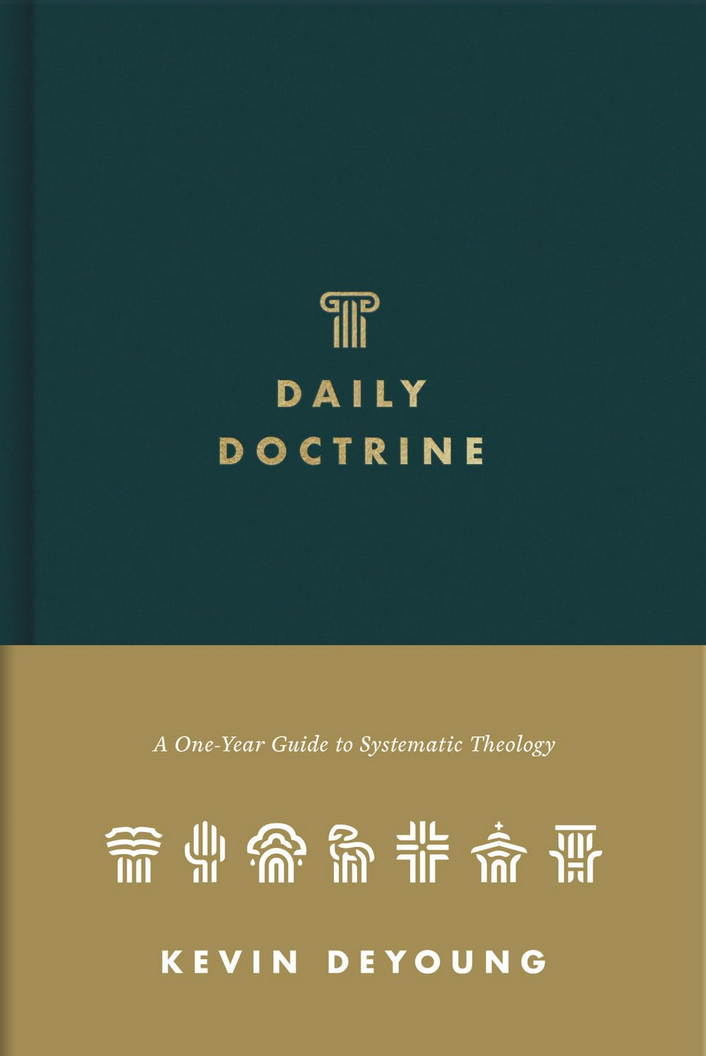
Daily Doctrine: A One-Year Guide to Systematic Theology
By: Kevin DeYoung
With every book Kevin DeYoung writes, his goal is to take complicated or hard to understand concepts and theology and bring it to an accessible level.
“I think I can best serve the church by reading the old, dead guys (and some living people too), digesting their technical arguments and terminology, taking the best of their insights, and then writing with clarity and concision for busy pastors, students, leaders, and laypeople.”
I love that he does this because I am one of those laypeople who wants to learn all the theology but I don’t have the time or knowledge to read original manuscripts or all the old theology books and understand them.
I love that he does it for me and I have come to trust his teaching. I have read many of his books and nothing he has written that I’ve read thus far has given me pause or contradicted what I believe to be true.
Daily Doctrine is his passion project to write a book of systematic theology that can be understood by anyone. As he writes in the introduction, it’s not groundbreaking stuff. If you’ve studied systematic theology in other contexts, much or all (depending on if you come from the Reformed tradition) may be familiar. That’s a good thing; truth is eternal.
Maybe you’re wondering why you should consider reading this book if you don’t already have an inner drive to study theology.
DeYoung says, “The reason we care about theology, the reason we write about theology, the reason you are reading a book about theology is so we can know God more deeply, enjoy him more fully, and walk with him more obediently. We do the hard work of careful, precise, intellectually demanding theology that we might see and savor the glory of God in the face of Christ.”
It’s not so we can puff ourselves up with knowledge, but it’s to draw us near to our Lord and Savior that we might love him better and worship him more fully.
Systematic theology, specifically, tries to answer the question, ‘What does the whole Bible say about this?’ The topics can be organized in different categories or ways.
DeYoung breaks the information into the traditional seven main topics (plus an eighth one— Covenant or how God relates to his creation— that is technically part of Anthropology)
Prolegomena (doctrine of Scripture and the general ‘rules’ of how we study theology)
Theology Proper (doctrine of God, the Trinity, decrees, creation, providence)
Anthropology (doctrine of man’s creation and fall)
Christology (the person and work of Christ)
Soteriology (doctrine of salvation- how we are saved and live by the Spirit)
Ecclesiology (doctrine of the church- how it is structured and functions)
Eschatology (doctrine of last things or end times)
The book is divided into 260 ‘bite-sized’ chunks of theology that are meant to be read over the course of a year— five days a week. This is generally how I chose to read it, though I often read 2-3 per day to catch up on missed time or because some concepts were discussed over multiple days and I wanted to take it all in in one sitting.
I chose to have a separate notebook where I took notes and copied down definitions and things. I find that writing things down helps me remember them better.
You can also just use this as a reference book, looking up specific questions or concepts you want to know more about.
As I mentioned before, I trust DeYoung’s theology and writing, so I expected to agree with everything in this book, especially because my theology is generally pretty Reformed.
I was a little surprised when I got to the Ecclesiology section of the book because that’s when I started to disagree with some of what he said. To be clear, it was not major doctrinal beliefs but more of the denominational differences with baptism, the Lord’s Supper, deacons and elders, etc.
For example, DeYoung is Presbyterian and I hail from the Evangelical Free denomination so he was arguing for infant baptism whereas my tradition practices believer’s baptism. I found it interesting to hear his explanation and how he shows the Bible supports that. It definitely gave me things to think about.
And then, of course, there are lots of varying ideas surrounding eschatology. I have not done much study on that yet and tend to feel like focusing too much on that part is a distraction from more important or clear doctrines. I wasn’t sure if I agreed with DeYoung on this section, but I also didn’t necessarily disagree either. It was nice to see a concise breakdown of the differing positions and the main differences between them.
Recommendation
This is a great, accessible book on systematic theology— that also looks pretty and includes a ribbon bookmark!— that I am glad to own. It sharpened my beliefs as I read through it and it will be a great resource to go back to when new questions come up or I find myself having to explain heady things to my kids.
I would imagine that those who are not Reformed in their theology may find more to disagree with in these pages— or perhaps after seeing things laid out so clearly, may cause them to adjust some of their beliefs— but for sure for readers who are Reformed, I think this book will help you understand more fully why you believe what you believe.
There are denominational differences in a couple chapters, but overall, this is an excellent read and resource that I would highly recommend adding to your shelf!
You can order a copy of this book using my affiliate link below.
Share this book review to your social media!