
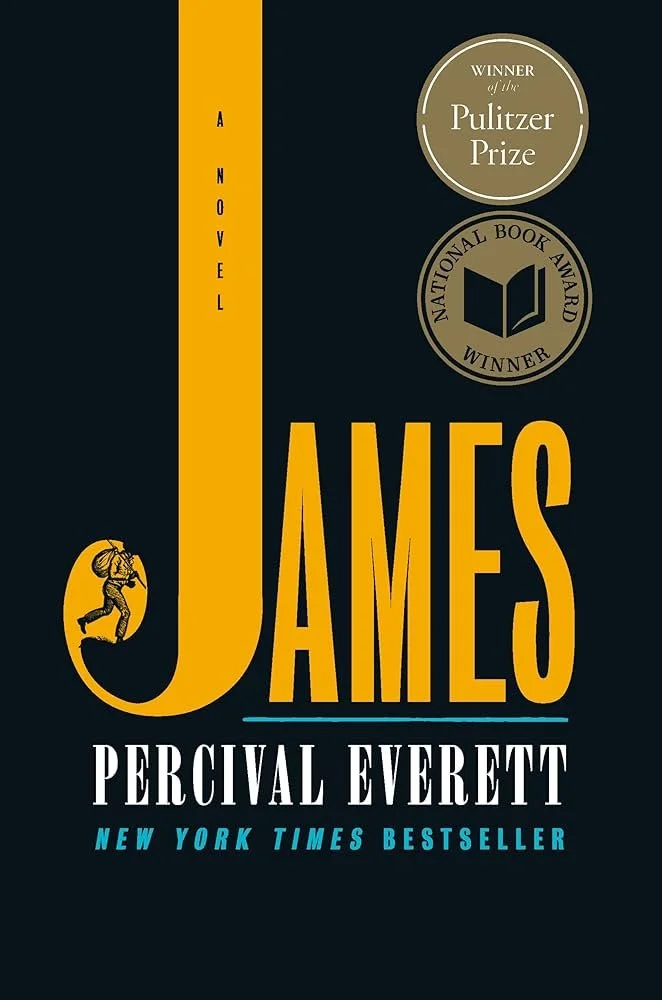
James
By: Percival Everett
[Fulfilled ‘A book from Jimmy Fallon’s Book Club nominees’ prompt as part of Shelf Reflection’s 2025 Reading Challenge]
[Nominee for ‘Best Historical Fiction’ and ‘Best Audiobook’ categories of the 2024 Goodreads Choice Awards Reading Challenge]
“‘Belief has nothing to do with truth.’”
James was a hard, but compelling read. It is a new take on Mark Twain’s The Adventures of Huck Finn told from the POV of Jim, the runaway slave.
It has elements of satire and humor in one breath and then in the next, severe injustice and heartbreak. You become highly invested in the life of James and his journey to freedom. Even though we do get a potentially ‘good’ ending, we can’t help but be sobered that in reality, so many slaves were unable to realize the same life that James was able to.
James vs. Huck Finn
I admit, somehow I had never read Twain’s book. (It’s possible I wasn’t overtly encouraged to because of all the n-words.) I’m sure the reading experience would have been better if I had known what Twain had written and been able to tell where Everett diverged from that, telling his own story. I’m sure a lot of readers liked that they were familiar with the story and could fill in the gaps of Huck’s side of things as they ventured into James’ version of the events.
After I finished James, I read the Sparknotes of Huck Finn so I could figure out what I was supposed to be getting from this story.
If an author is going to ‘re-write’ a classic, they must have a specific message they wanted to portray. I needed to know what message Percival Everett was trying to tell me.
Here’s what I gathered.
(Because we’re talking about a classic, I’m not going to worry about spoilers— you’ve had over a hundred years to read and know about it)
The beginning of James follows pretty closely to Huck Finn: Huck fakes his own death to escape his abusive father and runs into Jim (aka James) who is a runaway slave after finding out about his master’s plans to sell him. Together Huck and James venture down the Mississippi River encountering all kinds of dangers as James tries to figure out how to go back and buy his family and escape to freedom.
But in Huck Finn, instead of being sold to some random master later in the book, Huck finds James with Tom Sawyer’s aunt and uncle. Then Tom helps Huck devise a plan to help James escape. But during the escape, Tom gets shot in the leg and instead of running, James doctors him.
Then Huck and James find out that James is actually free. While they were running about Miss Watson had died and freed James in her will. Tom Sawyer knew but thought an escape would be a fun adventure. So in the end James is free after all.
Everett does not take his story in this direction at all. There is no freedom that just befalls James. There is no fake escape.
Why would Everett change it in this way?
The main thing that comes to my mind is: agency.
A slave has very few, if any choices. They didn’t even get to pick their name— Jim was his slave name but James is what he chose for himself by the end of the book.
I believe Everett wanted James to feel his rage at the injustices in his life and the lives of other slaves. He wanted this outrage to inspire him to decide he will no longer stand being a slave. He is thus propelled to go find his freedom and make choices to that end. He was able to decide what risks he was willing to take and what direction he wanted to go. He got to make a plan and change the plan whenever he wanted to. He even got to experience an impossible choice— who he was going to save. And we see that even agency comes with hardship.
Agency.
At one point Everett looks at those who justified and instituted slavery and calls them enemies: “I chose the word enemy, and still do, as oppressor necessarily supposes a victim.”
I thought this was a really important distinction James made. As part of his agency, he chose not to be a victim.
In another place this exchange occurs between Huck and James:
“‘To fight in a war,’ Huck said. ‘Can you imagine?’
'Would that mean facing death every day and doing what other people tell you to do?’ I asked.
'I reckon.’
'Yes, Huck, I can imagine.’”
He was not a victim. He was a fighter in a war for justice and freedom. There weren’t a lot of choices he could make and the ones he could were highly dangerous, but he made them all the same.
Identity and Language
I think James almost becomes synonymous with the stolen pencil in his pocket that he uses to write his own story. His acquisition of the pencil is a turning point in the book. Throughout all the mishaps on the river and in the woods, he never loses the pencil— which I believe represents his chosen identity.
James finds a biography of a slave, as told to the author of the book, and unlike that, he’s going to be “a man who will not let his story be self-related, but self-written.”
He— not his master, not another ‘superior’ white person— is going to write his story.
“At that moment the power of reading made itself clear and real to me. If I could see the words, then no one could control them or what I got from them. They couldn’t even know if I was merely seeing them or reading them, sounding them out or comprehending them. It was a completely private affair and completely free and, therefore, completely subversive.”
The power of words and language is another big theme of this book.
We see that the slaves ‘translate’ standard English into ‘slave speak’ when they are in the presence of white people.
“White folks expect us to sound a certain way and it can only help if we don’t disappoint them.”
When a white character is confronted by James speaking perfectly good English, James notes:
“The remarkable truth, however, was that it was not the pistol, but my language, the fact that I didn’t conform to his expectations, that I could read, that had so disturbed and frightened him.”
When I looked up an interview with Everett Percival, he explains that “any enslaved, imprisoned or oppressed people find a way to speak to each other in the presence of their oppressors that will not allow entry.”
Having read Amanda Montell’s book Cultish: The Language of Fanaticism which talks about language as a way of belonging and joining a group, it was interesting to think about language being formed by an ‘out group’ to restrict the ‘in group’.
How important communication is to a person’s belonging!
In that same interview, Everett reveals that he wrote the book to give Everett a voice but also to explore identity. The identity given to us versus the one we claim as our own.
We talked about identity in terms of agency and one’s name, but another aspect of where identity and language converges in this book actually falls short of how I view identity.
The reason the white people feared a black person who could articulate Voltaire was because they justified slavery in their minds by viewing dark-skinned people as inferior and stupid. I think Everett portrayed James as intelligent and well-spoken to point to his humanity.
If James is human, then how could they justify treating him like an animal?
I do agree with the choice to show that intelligence is not only found in one ethnic group.
But I would go even further to say that our humanity is not proven by our intelligence. Our humanity goes much deeper than that. A person does not gain worth and identity once their intelligence is determined. There are no qualifiers to being human other than existing.
Our humanity, and dignity, and value is found in being created in the image of God. James should be humanized not because he knew Voltaire but because God knew James. He created him. And that’s all it takes to ‘earn’ the right to life and worth. To be human. The ignorance of white people to believe something else is one of the most horrific things in our country’s past.
I can’t help but also, then, insert this quote from the book:
“A man who refused to own slaves but was not opposed to others owning slaves was still a slaver, to my thinking.”
This is a matter of humanity and dignity and right to life and even those who didn’t own slaves still needed to stand against the practice that others employed under their own corrupted morality.
Percival Everett might point to certain racial injustices still happening today, and it is right to do so, but I think we also have to apply these truths to the practice of abortion.
I know many Christians who say they would not personally have an abortion but they don’t feel they can oppose someone else with different convictions. I think to hold that belief is to be the same as those not opposing slavery.
At the point of conception, at our existence, we have a right to live; our humanity is determined. In God’s infinite wisdom and mercy he is the sole Author of life and we don’t have to earn our dignity.
To backtrack to the ‘identity we’re given vs the identity we claim’ I think it’s helpful to think about what identity means. To claim an identity today seems to be reduced to deciding what gender we are and claiming a new name. But again, just like our humanity goes deeper, so does our identity.
We don’t have to accept identities pushed upon us by other people, just like James did not need to accept that he was a slave and incapable of agency, but there is someone who gives us an identity and that is our Creator. We are his creation, his children. That is the only identity we need. We don’t need to bear the burden of claiming the right one. The book Walking in Unity does a great job of talking about identity and I would highly recommend it.
We can even tie this idea of identity into the first quote of this review about belief not having anything to do with truth.
James observes:
“Folks be funny lak dat. Dey takes the lies dey want and throws away the truths dat scares ’em.”
We may believe certain things about our identity, but that doesn’t mean they are true. Hopefully we can be people who seek the truth and not just surround ourselves with lies for the sake of our comfort. Life is too important for that.
Negative Reviews
It’s one of those books where it’s unpopular to write a negative review. But some found the courage and I will say that some make good points.
Some readers felt too distant from James and that Everett didn’t do enough to make him stand out from Twain’s version of his character.
It seems like some readers struggled with the juxtaposition of humor and satire alongside the horrific. Sometimes it’s hard to read books with such varying emotions. I can see why some might not like that style of writing. At the same time, I think it’s still a picture of reality. Even in the face of death or danger, we can still find joy or humor in things. We are complex beings with complex emotions. Just because we find ourselves in terrible circumstances doesn’t necessarily mean we have to only feel fear or anger or despair.
Another thing that was mentioned is the lack of female characters or only using female characters to be victims. The only females in the story (other than James’s wife and daughter) are victims of rape and a gunshot.
I’m not sure how I feel about the lack of substantial female characters.
I thought it was interesting that Everett says this of his book: “I hope that no one thinks that my novel is about slavery. There’s a difference between writing a story about people who happen to be slaves and writing a story about slavery.”
I think the primary scope of this book, as it was titled, was meant to be James. Part of James is his relationship to Huck and Huck’s character arc of seeing James’s humanity. I think I would have liked to see more of his relationship with his wife and daughter, but again, the scope, because of the Huck Finn story, was primarily about his running away and trying to get back.
Could Everett taken more liberties and added in more female characters with a different purpose than just being a victim? Yes. And I can’t say why he chose not to.
But I don’t think the lack of strong and prominent female characters should mean this book is less than. And if we read between the lines we do know that throughout James being away, his wife was having to be the sole protector of their daughter and had to have shown immense strength in the face of uncertainty and fear of what was happening with her husband. We don’t get to hear her side in this book, but we know she was there.
For me, the things I wish were different:
I would have liked more about James’ personality and his relationship with his family.
I didn’t fully understand the situation with Miss Watson and Judge Thatcher— who were they and were we supposed to like them?
What’s the deal with Huck’s mom?
I liked that there was a twist at the end of the book and was surprised by that. At first it made me feel happy but then it evoked some questions and made me see James in a different light that I wasn’t sure how to feel about.
After all that James went through with Huck, I was a little let down by how it resolves at the very end. I’m not sure we were given enough information to understand how that played out. I don’t want to give anything away so this is vague, but I wanted to be able to feel confident about both James and Huck’s futures, but we only get partial clarity for James and really nothing substantial about Huck’s future.
Recommendation
It’s hard for me to truly evaluate this book like those who are familiar with the original Huck Finn novel. I can’t say whether this was an improved upon re-write, whether he did such and such justice, etc.
But as someone who never read it and has nothing to compare it to, I found the book to be compelling and hard to put down. It was easy to be invested in the story.
It’s weird to say that you enjoy a story that reveals such horrific parts of history— and I wouldn’t want to read books like this one right after another— but in small doses it’s good to be reminded of what happens when a person’s humanity requires qualifiers. For history to not repeat itself, we need to be exposed to it.
Overall, I would say this book is worth reading.
[Content Advisory: 1 f-word, 5 s-words, 69 n-words (which is far less than Huck Finn apparently); a rape scene; many instances of violence and degradation]
You can order a copy of this book using my affiliate link below.
Share this book review to your social media!