Platforms to Pillars
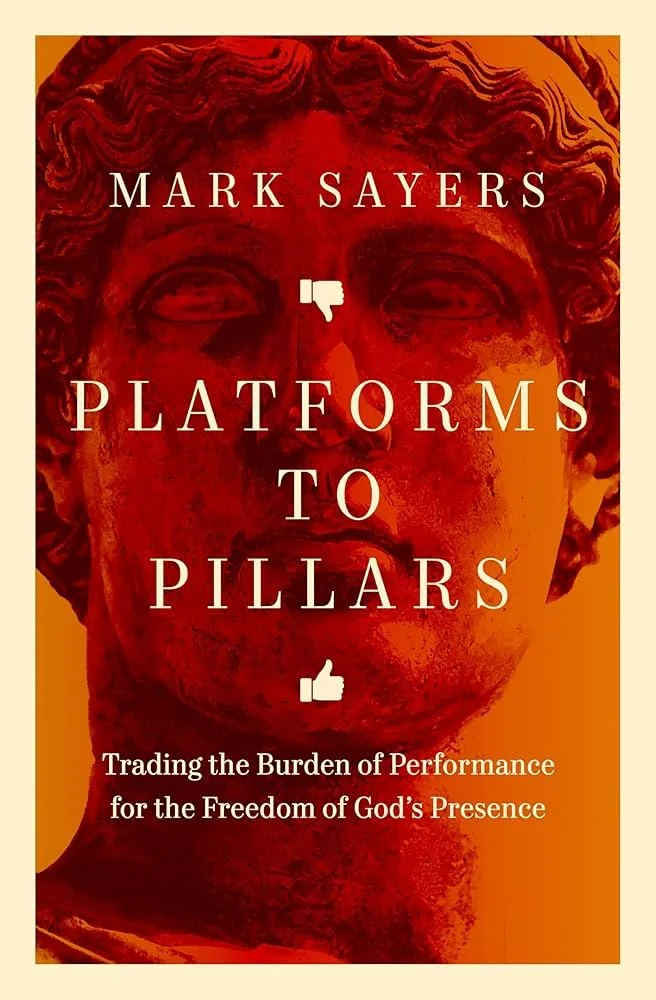
Platforms to Pillars: Trading the Burden of Performance for the Freedom of God’s Presence
By: Mark Sayers
“Instead of examining technologies in and of themselves, this book will explore the ideologies behind our gadgets and the consequences of the platform self and the platform society. It will also invite us to consider the alternative to staring down obsessively at our screens. That is, looking up and seeing a greater vision of the grand pattern God is writing, the building of spiritual pillars in today’s world.”
“The failures of the platform society are causing many to question and a growing number to explore faith.”
This was a super interesting read! I learned so much. I loved the incorporation of history and all the connections Sayers made throughout the book.
It is a very layered book and sometimes feels like it jumps around a lot, but it was helpful that he frequently put in ‘key point’ pull outs and then listed them at the end of each chapter to summarize what was said.
I found this book highly relevant. It offers a lot to think about as we figure out how to live in God’s world.
When I listened to the author talk about his book on the Ministry Deep Dive Podcast they called this book a work of cultural apologetics. Cultural apologetics is a way of looking at the gospel and the Christian faith, not merely to prove the existence of God but to answer ‘is it good, beautiful, and life-giving?’
In this particular book, Sayers looks at how we became a platform society. A platform society intensifies individualism, elevating self and the needs of the self and replacing institutions that are viewed as restrictive.
Sayers says that a platform is “a mentality, a way of approaching life, that promises to reinforce our uniqueness, deliver on our desires, and offer validation and visibility.”
Carl Trueman studies “The Rise and Triumph of the Modern Self” in his book titled thusly, tracing the roots back to the 60s and 70s when institutions (like church or the family unit) were seen as obstacles to true self-expression. (Strange New World is a shorter version of this material and is a good supplemental read to Sayers’ book.)
Trueman’s focus in looking at individualism connects with the sexual revolution; Sayers’ focus is looking at individualism’s effect on leadership and community and how the promises of the elevated self are not actually delivering, leaving people feeling isolated and unfulfilled.
He calls it the ‘platform pain point’— its failure to “deliver our wants, desires, and needs in the face of real-world challenges.” Our expectations were not met. Now we’re stuck in this performative, isolating world of self-worship.
What’s interesting (and ironic) is that individualism began as a way of expressing autonomy, being a unique individual and standing apart from the crowd. But today, everyone has a platform to some degree. The digital platform itself has not created unique individuals, but ingrained a more herd-like mentality and preoccupation with what everyone else is doing and thinking. It is actually undermining individualism and independence.
Technology and the digital platform are obviously part of the discussion, but what was really interesting to me was how Sayers traces these ‘platforms’ all the way back through history to the Egyptian culture. While secularists may think we are progressing forward, we are actually regressing into ancient forms of power and social structures.
“Many of the roots of the platform society can be found in the ancient past. This is most evident in the religious longings that operate underneath its surface.”
A tour guide at a museum in Rome told me Egypt matters for nothing, but apparently it matters for something, because our society is mirroring the Pharaohs’ attempts to become god. To elevate the self, to attempt to escape into something greater. A seemingly limitless paradise.
Platforms
There are several historical platforms that Sayers talks about, drawing connections to the modern world.
The first is the ‘dais’ platform. Used for British royalty, it actually is a continuation of Egyptian practices: “The anointing of the king, the crowning, the giving of oaths, and processions were also used in the coronation rituals of the pharaohs.”
The dais is a physical representation of how the monarch sat upon their throne, atop an entire social structure, ruling their kingdoms. Their desires were what was most important. And their job was to bring order to chaos.
But again, the irony is that in today’s world where equality is king, the platforms we feel we all deserve promotes inequality instead.
“We expect fairness, but the platform frame creates constant social comparison and competition. This works against community cohesion, creating social chaos and conflict.”
We live in a society “that attempts to elevate us and empower us with godlike ability, yet that also detaches us from reality and leads us into self-deception.”
A second platform we’ve mimicked is the Greek stage.
“We have returned to something like the situation in ancient Greece, a culture in which the line is blurred between stage and everyday life, acting and authenticity.”
[Sidenote: Sayers blew my mind here— did you know the Greeks had the first robots?! They created automatons: self-moving structures using steam, water and air pressure. That’s nuts.]
The natural effect of a platform saturated in performance and having to measure up or appear a certain way is no doubt a lot of shame, anxiety, fear of rejection, and addiction. Further, it takes things that were previously just areas of pleasure and turns them into ‘content fodder.’ Eating a meal, reading a book, taking a walk all become a labor that must be presented or performed, broadcast to the world.
This stage even makes protesting the performance into a performance.
A third historical platform that remains intact today is the market (banca). Ancient markets and banks had raised platforms where they would do their business. Our platform society has a major function of market: everything is for sale. Sayers said in the podcast, if something is free— YOU are the product. Our eyes are targets for consumption.
The collection and selling of data is a primary market today.
“Data is now a resource that rivals oil and gas in its distribution and value. This helps us understand why billions of dollars are being invested into AI, for the scale of data being harvested is too vast for humans to handle.”
The market facet of our platform society blurs the lines between the private life, civil society, the state, and corporations.
He talks here about the introduction of the credit card and the financialization of the world that promoted indulgence and instant gratification. He connects it here with the sexual revolution, calling that and the market revolution as two sides of the same coin of hyper-individualism. A competing pursuit of 'having it all’ with no consequences.
“our economic and social order, built upon large digital platforms, creates a new dynamic of exploitation that is highly effective ‘because it does not operate by means of forbidding and depriving, but by pleasing and fulfilling.’”
It is convicting to think about this market as being a seduction, luring us in under a pretense of freedom that ultimately leads us to giving away our time, attention, and emotion for their profit. Sacrifice is at the center of every culture, but as Christians, on what altar are we sacrificing?
Which is the segue into a fourth historical platform emulated today: the altar. The raised platform in temples— the location of “ritual, belief, and worship.”
“Societies that live by the flesh will be places that worship influential individuals, tribal dynamics, and the sexually powerful and attractive. Material gain and displays of violence and military power will be normative.”
Paul reminds us in Romans 12 that as Christians we offer our bodies as living sacrifices, as an act of worship. Meaning what we do with our bodies and our minds matters. When we live faithfully and obediently, seeking to be holy as God is holy, we are offering ourselves, making our lives a sacrifice for King Jesus and his divine kingdom.
A platform society wants us to sacrifice ourselves in an exploitative way that returns us no lasting benefits. It is a meaningless existence atop a human pyramid.
If we are looking for something good and beautiful and life-giving, what Christ offers us fits the bill. In stark contrast, our platform society boasts only a futile, anxious, isolated, exploited, and unstable existence.
Pillars
Most of the book is spent dissecting the various platforms and looking at the history and ideologies behind them. But this book does not only deconstruct the platforms in our lives, it builds something as well.
The counter to a platform society are pillars. You can conjure a picture in your mind of what a ‘pillar of the community’ might look like.
Sayers describes the functions of pillars: to be supportive, to work in unison, and to create space.
“Through their resilience, courage, and fortitude, pillars bear loads for others by taking responsibility and offering support and encouragement. They work with other pillars to pass down the generations’ vital knowledge and wisdom through instruction and the example of their lives. Living this way, pillars create space for others to succeed and flourish. They do this through service, sacrifice, self-denial, and living for the greater good. These truths operate in any human culture or community.”
That is the essential call to action in this book. To step off of our individualistic platforms and seek to be in community, building one another up, sharing truth, and enabling others to flourish.
We will have to bear the social pressure of going against the cultural flow. We will have to be content with supporting even the seemingly small and insignificant, trusting God’s work in the building process.
He pulls out the imagery in Revelations 3 when God says he is going to make his people pillars of his new temple in the New Jerusalem.
Scripture says that we are now the temples. We no longer need a temple building to offer sacrifices for our sins. Jesus destroyed the temple and rebuilt it in three days when he died and rose, paying our debt. Now his Spirit lives inside us. We are the temple and our bodies are the living sacrifice. We are the pillars in God’s temple.
“Our lives matter. When we live them for God, He uses them as building material for the living temple in the world.”
Mountains & The Exodus Pattern
“Platforms are human-made mountains, attempts to create ladders to heaven. Their origins are religious—to create glory for humans.”
Sayers reminds us of the Tower of Babel, a story we’re familiar with. The ziggurat structure mirrors the shape of mountains. Other cultures all over the world created similar structures.
“Ziggurats were seen as heavenly elevators that enabled the gods to descend from heaven. The tower was not built for humans to climb to heaven and leave the earth. Instead, it was a way for the gods to come down and set up heaven on earth. A ziggurat, with its small room atop where the gods could dwell on their way to earth, was a kind of divine stamp of authority, justifying the regime below and marking the monarch as divinely ordained to rule.”
This is such an important connection for us to understand in our platform society:
“The society that dethrones God will always revert to the temptation to enthrone humanity atop the human pyramid.”
I thought it was cool when Sayers talks about the role of mountains in the Bible. He said it could be argued that Scripture is the story of four mountains: The Mountain of Eden (didn’t know Eden was on a mountain!), Mount Sinai, Mount Zion (the temple was on a mountain), and The New Jerusalem.
Mountains were symbolic of heaven and earth meeting— humanity with the divine. God met with his people on mountains.
In Exodus, after the Israelites leave Egypt, they stop at Mount Sinai where Moses meets with God and gets the terms of God’s covenant with his people. Throughout this book Sayers keeps pointing back to Exodus— just like Scripture. The cross is the central to Scripture and the Gospel, but God’s deliverance of the Israelites form Egypt was a sign of what was to come.
Sayers emphasizes the ‘Exodus pattern’ as our path to being a pillar.
“In the Exodus pattern, God delivers His people from chaos, idolatry, and exploitation so they can worship Him upon His holy mountain. As they encounter Him, they are called back to their original vocation: to be a royal priesthood, imprinted by God, and imprinting the world with His ways.”
The opposite of the Exodus pattern is the pattern of exile. When we move away from God’s mountain and seek to build our own, we enter into false worship:
“Often, these compromises happen incrementally, yet their direction is always the same—a journey to false worship. Worshiping the creation rather than the Creator. False worship inevitably leads to captivity. Captivity leads to oppression.”
God's Word shows us how to live faithfully and obediently. How to worship him as Lord.
The platform society is a performative existence that seeks social power and profit, and demands wanton sacrifice.
God’s way is the path of true freedom where our identity is secure and eternal in the family of God, and all our needs are met in the perfect Savior who delivers us from ourselves.
One Critique
If I had one critique of this book it would be the small amount of Scripture and gospel truth. Granted, this book is a historical overview and cultural commentary and not meant to be a theology book. But I think it could have done more to show what freedom in Christ looks like today.
In some ways the application is a bit vague. But perhaps to get too specific takes away from personal conviction in people’s specific and unique spheres.
Maybe we could have heard more stories about people living as pillars now and quotes from them on the challenges and blessings of doing so.
I also couldn’t tell if Sayers was wanting to focus more on the digital platforms, but I think there are a lot of people who aren’t on social media and may think this book doesn’t apply to them. It might have been helpful for more thoughts on what shape platforms can take if you don’t have a big digital footprint… unless those people are more immune from the the effects of platform society?
Obviously the scope of the book can’t be too broad or the book would be hundreds of pages and my review just as many, so I don’t stress this critique too much. I think the book still accomplished what it set out to do.
Recommendation
My review was so long you probably feel like you don’t need to read the book at this point, but I do still think you would benefit from reading it in its entirety. There is more I didn’t bring up and Sayers explains things better than I’ve done here.
It’s actually not too long and reads fairly quickly.
I believe the message is one we all need to hear. The church is trying to figure out how to live in a platform society and a digital era. This book reminds us of what is vital to thriving communities and our need to be in the presence of God.
I think even being in the habit of asking of ourselves— ‘is this a platform lifestyle or a pillar lifestyle?’— will be essential as we make decisions about how to spend our time, our resources, and our minds. We are all under immense pressure to do life according to the rules of culture and we feel the rush of the rat race in building and using a platform.
And God may choose to give people platforms, but even so, this book offers a solid foundation and good reminders for how to avoid doing what Herod did with the Temple Mount when he leveled God’s mountain and created something different that fed his ego.
“We are called to more than avoiding the pitfalls of our platform society; we are called to live as pillars, patterned by God as He builds His living temple in the world.”
[Random Fun fact from the podcast episode linked above: I learned that the word ‘selfie’ came from Australia which makes total sense because Aussies like to slang words with -y and -ie. I had also recently learned that they call electricians sparkies. They just have a much more fun vocabulary over there…]
Further Relevant Reading
I just listened to a podcast where Brad Edwards talks about his book The Reason for Church: Why the Body of Christ Still Matters in an Age of Anxiety, Division, and Radical Individualism and there’s a lot of overlap and connection. He even mentioned Mark Sayers so this would probably be a pretty good tandem read.
The Freedom of Self-Forgetfulness by Timothy Keller
How Church Could (Literally) Save Your Life by Rebecca McLaughlin
Strange New World: How Thinkers and Activists Redefined Identity and Sparked the Sexual Revolution by Carl R. Trueman
God, Technology, and the Christian Life by Tony Reinke
12 Ways Your Phone is Changing You by Tony Reinke
Do Not Be True to Yourself by Kevin DeYoung
Rediscover Church: Why the Body of Christ is Essential by Collin Hansen, Jonathan Leeman
**I received a copy of this book via Moody Publishing; this is my own honest review.**
You can order a copy of this book using my affiliate link below.
Share this book review to your social media!