
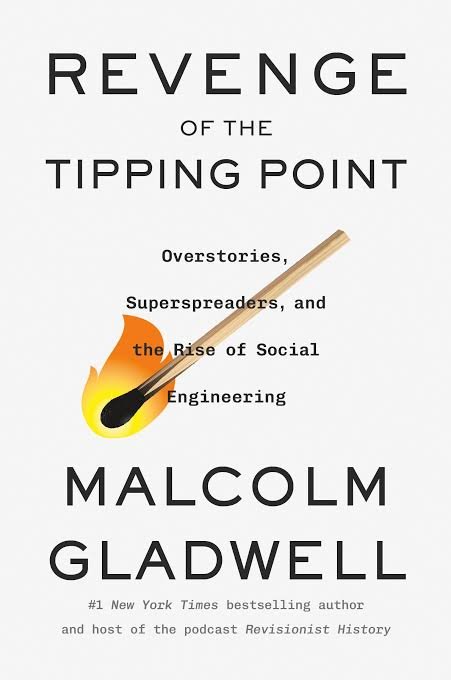
Revenge of the Tipping Point: Overstories, Superspreaders, and the Rise of Social Engineering
By: Malcolm Gladwell
[Nominated for ‘Best Non- Fiction’ in the 2024 Goodreads Choice Awards Reading Challenge]
“If the world can be moved by the slightest push, then the person who knows where and when to push has real power. So who are these people? What are their intentions? What techniques are they employing?”
Surprise! It’s TV!!!
But first.
My initial thoughts after reading this book: Some interesting things to think about, but I’m not sure what I’m supposed to do with this information.
While I have read and enjoyed a few of Gladwell’s books, I have not read his original Tipping Point book. I can’t offer any insights on how this compares to that book and if it feels like a re-hashing or fresh information— you’ll have to find other sources for that.
I think the point of the book was to help us make sense of social epidemics and recognize things we can do to avoid them.
To that end, there are certainly things we can affect, but so many of the things he points out seem inevitable and hard to change or perhaps even wrong to change.
Let me explain.
In one chapter he talks about how cheetahs all have the same DNA (as if they’re twins). Because of the lack of diversity in DNA, their population is susceptible to mass deaths due to disease because of their uniform immune systems.
He then connects this to a heartbreaking suicide ‘epidemic’ at a school that had monoculture— uniform ideology and values. Unlike most high schools that have all kinds of thinking, including rebels and status quo challengers that question and oppose new ideas, this particular school seemed to have no defense against a harmful concept and so many students were taken captive by the idea to end their lives.
In another chapter he explains how there was a major conference in Boston in 2020 that ended up spreading Covid to thousands of people and that it could somehow be traced to just a few people who were actually ‘superspreaders’— meaning they were people who expelled a higher quantity of aerosol particles when they talked and thus infected people at a much higher rate than normal people.
He also looks at air pollution from cars and notes how studies keep showing that “Somewhere around 10 percent of vehicles are, at any given time, responsible for over half the automobile-based air pollution.”
He connects this to the opioid crisis by showing that it only took a small fraction of doctors to abuse the prescription process in states with less oversight on prescriptions to start an entire epidemic of drug addiction.
So in the first set of examples, I don’t take away new information but it confirms what I already know to be true: we need to have freedom of diversity of thought and critical thinking skills and not blindly follow the crowd.
In the second set of examples, it feels like I’m supposed to take away: if we identify the superspreaders we can stop epidemics. In some ways yes— it seems wise and appropriate to identify and stop doctors who are breaking the law or to add laws that make it harder for doctors to get away with prescribing addiction to people.
However, is it wise and appropriate to identify people who breath differently and make them quarantine in their houses when they are sick so that they don’t infect others? I don’t think so. We already saw how social distancing ‘rules’ may have prevented some spread but caused deaths in other ways including depression, anxiety, and loneliness.
Is it wise and appropriate to identify the cars that cause the most pollution and not allow people to drive them? I mean I like the idea to stop blaming everyone for a problem that should be attributed to one small group of people— that would be nice to enforce in a lot of spheres… but how much oversight should be had is a tricky question.
In this way, I found this book a little frustrating. I also didn’t think it was organized very effectively or clearly.
It seems like he made some observations— that make sense and very likely could be true— and then found singular and somewhat obscure examples as evidence. We’re looking at one species of animal. One high school with a high suicide rate. One conference that infected a lot of people. One massive increase in the use of one word (holocaust).
I think these are all very interesting things to consider, but what broad purpose can this information actually serve?
I don’t think Gladwell did a very good job of presenting a thesis and walking us through his trajectory of thought from one story to the next and how it all connected. Even within chapters he jumped from one example to the next at really unnatural times leaving both stories feeling unresolved for most of the chapter.
I would have preferred him to cover one whole story and then say— ‘in the same way’ and then connect it to another. The back and forth may have been intentioned to be more dramatic or add suspense, but we’re not reading a thriller here. It’s an informative non-fiction book. I would rather have clarity than be on the edge of my seat about what happened to the cheetahs.
I think it would have been hugely helpful if he had some sort of conclusive statement he could keep pointing back to, maybe that even had bullet points: the three things every social epidemic has. And then as we read each chapter we can clearly see how it fits into the puzzle. There aren’t even summary paragraphs at the end of each chapter to explain where we started, where we are, how we got here, and where we’re going. It felt a little all over the place.
I read the very last paragraph of the book and I was like— Oh! So that’s what he was trying to do! But by then it was too late.
Let me share it here so if you haven’t read the book yet, perhaps it will help guide you through his points and you’ll have a better reading experience than I did:
“Epidemics have rules. They have boundaries. They are subject to overstories— and we are the ones who create overstories. They change in size and shape when they reach a tipping point— and it is possible to know when and where those tipping points are. They are driven by a number of people, and those people can be identified. The tools necessary to control an epidemic are sitting on the table, right in front of us. We can let the unscrupulous take them. Or we can pick them up ourselves, and use them to build a better world.”
There are two big things that stuck out to me while reading the book.
The first was the idea of the tipping point and the principle of the magic third. This was both a positive and a negative realization. The idea of the magic third (or fourth) was the amount of people it took to create a shift in thinking or belonging.
For example— having a board of 9 people have at least 3 who are women is a tipping point for women feeling like they are heard and taken seriously on the board. This felt helpful to recognize in terms of wanting to foster environments that make people feel welcome, seen, and heard— a member, not a token.
It’s also helpful in recognizing, you don’t have to change 100% of people’s minds to inspire change, but if you just change 25% of people’s minds, the rest end up following.
But conversely, this can be used as a gatekeeper more than a gate-opener. To maintain a situation from reaching a tipping point, it is the number used to deny others access.
For example— the gentrification of neighborhoods in the 50s. Once a neighborhood was a certain percent black, all the white families moved out. It caused realtors or bankers or whoever the powers may be to deny people the right to buy a house in a certain neighborhood for fear of reaching a tipping point in race distribution.
It’s apparently also utilized at many major universities and colleges by admitting students not based on merit but more on their athletic ability or their race in order to maintain a certain environment and prevent an alternative outcome.
This is what I think Gladwell means when he talks about the unscrupulous using the tools of engineering epidemics for their own agendas.
But I think there are differing opinions on what is good and what is bad. Or to what degree authorities can/should manage these tipping points. It feels like a slippery slope to loss of freedoms.
The second thing was the construction of the overstories. He says “Communities have their own stories, and those stories are contagious.”
I learned that the use of the word ‘Holocaust’ in relation to what happened in WWII was virtually unused until the 70s. That whole story was crazy for me to learn. But what Gladwell observed as the catalyst for the change was a miniseries done on TV that exposed the realities of the concentration camps.
Called ‘Holocaust,’ it was put out by NBC in 1978 and was “one of the most devastating and unflinching history seminars in modern history.” Apparently half of America watched it and it had an enormous effect on the world.
He also traces the major changes in perception of the LGBTQ community to the popularity of the show Will & Grace.
And get this: In the 1970s someone did a study on people (liberals, moderates, and conservatives) who disagreed politically.
In most cases, they disagreed “strongly on hot-button issues only if they didn’t watch a lot of television. But the more television people of all ideological persuasions watched, the more they started to agree. When a large group of people watch the same stories, night after night, it brings them together.”
He quotes Andrew Fletcher who said, “If I can write the songs of a nation, I don’t care who writes their laws.”
This information was not necessarily surprising, but it was alarming and disheartening. Having recently read Scrolling Ourselves to Death which looks at Neil Postman’s book Amusing Ourselves to Death, I am just increasingly saddened by the power and influence the media has over people. People who aren’t thinking critically, but have been willingly molded into— in some ways— a monoculture by the entertainment industry.
One of the screenwriters/producers of the show Will & Grace said, “We knew that we had a win in the fact that there was an out, gay man at the center of the show… And so that’s how we fed this gay conspiracy to the American public.”
So basically, Gladwell reveals… the reason the world changes is because of the amount of TV people watch. That’s actually pretty sad. It’s just whoever happens to get a job screenwriting and producing. They can choose the stories and ideologies they want to feed America and America eats it up without much thought.
I hope this information is a wake-up call to readers to consider their beliefs and perceptions and why they have them. And then look at how much time they spend watching TV or absorbing social media.
I don’t even know what Gladwell was intending to say here, if he was saying it like it was a good thing or a bad thing, but it made me pretty disappointed.
Recommendation
I’m not sure how to recommend this book.
If you’re just looking for a book that tells some interesting stories or makes some interesting observations, this might be a good fit. Or if everything I shared in my review made you hungry for more, then read it in its entirety.
But if you’re looking for a clear and cohesive book with a call to action and a straightforward message, you would probably be disappointed.
At over 300 pages, it’s not a short book for nonfiction, and while I typically enjoy Gladwell’s storytelling, I’m just not sure this one ended up being worth my time.
Unless I completely missed the point of this book, I feel like my review probably hits all the main high points and you could probably call it good and not read the whole thing.
[Content Advisory: A handful of swear words]
You can order a copy of this book using my affiliate link below.
Share this book review to your social media!