99 Ways to Die
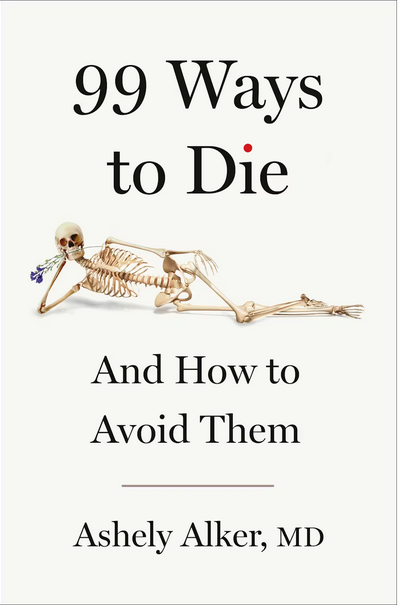
99 Ways to Die: And How to Avoid Them
By: Ashely Alker, MD
[Fulfills the prompt: ‘Book with a medical professional’ for the Shelf Reflection 2026 Reading Challenge]
[On my list of Most Anticipated Books of 2026]
Too much death. 1 Star.
Just kidding.
But I’m going to be honest: I thought this was going to be cautioning me against eating too much whipped cream, or warning me about sticking a fork in my ear in the exact wrong spot, or how my lawn mower can blow up, or if I sneeze during surgery I’ll get stabbed and die. Or even killer bird stuff— those murderous creatures.
I was looking forward to the bizarre and random ways of dying (that’s a weird sentence to type and applies to this particular book only).
Back in the day I used to catch a few episodes of the TV show 1000 Ways to Die and if I’m remembering correctly, there was some pretty crazy stuff (perhaps not my best choice in show).
But, I have to break it to you. This book is not like that.
Let me tell you who this book is NOT for: the hypochondriac. The person with pre-existing fears of illness, food, animals, bacterias, worms, traveling, invisible gases, and the like. You will live a much better life without this book.
For all the other freaks out there who love diseases… have at it.
I’m actually neither of these… although this book has unlocked some new fears I’m not happy about. I’m not death-obsessed or fascinated by parasites. I’m not that worried about germs (to my husband’s chagrin) and I have no interest in visiting the Amazon, the Outback, an underwater cave, or eating pufferfish.
So why did I read this book?
Purely curiosity.
Some say curiosity kills… but that was not covered in this almost 400 page book so I didn’t know better.
Unfortunately, this book ended up being quite the drag for me. I didn’t want to read about ACTUAL ways of dying like strep throat and TB and Ebola and high blood pressure, cocaine, measles, mold, water, cars, and gun violence. And I definitely didn’t need the chapter called ‘butt stuff.’
It was a bit depressing to read the statistics about how many millions of Americans are addicted to drugs, alcohol, or smoking or to know how many are infected with sexually transmitted diseases or to hear about all the children that came through Alker’s emergency department.
I did not look forward to picking up this book each day and seeing what else was in my immediate life waiting to murder me or being confronted with national— and preventable— statistics.
In that way, I guess this book was not really for me and explains why it has taken me two months to get through.
Granted, I did learn some stuff— like that a poop transplant is a real thing and why ‘A dingo ate my baby’ was really said— and was able to confirm my life rules like: no bats, hippos, bodies of water, bushes, eating poop, snails, or tapeworms, recreational drugs, or helicopter rides.
There was some humor (I wouldn’t call it hilarious…) and creativity in the way she described things:
“The brain’s blood vessels are like roads with semi-trucks full of oxygen trying to make their required delivery to different destinations within the organ, and the brain is an Amazon-addicted twenty-year-old with her mom’s credit card. The oxygen semi-trucks are never-ending.”
…and I appreciated her references to Blo-Pens, Murder She Wrote, Michelle Tanner’s horse accident, and Oregon Trail.
Plus once we got 60% of the way through and hit on animals it got a little bit more interesting— though possibly more terrifying (don’t Google Goliath birdeater).
[Important Question: How the heck do we know that the world’s oldest spider is this one specific trapdoor spider that lived 43 years until she was eaten by a parasitic wasp?! Did we Big Brother her and every other spider for 43 years?!]
Buuuuuuut overall 99 Ways to Die just fell short of what I think I wanted.
I think if it was shorter and perhaps less comprehensive, I think the learning part could have been enough for me even if it wasn’t weird and crazy. The chapters and medical knowledge about random diseases and bodily ailments felt too endless and repetitive. I don’t want anyone else telling me to exercise more and eat a balanced diet. Booooring.
I did appreciate the section on health influencers and how they love to employ correlations (rather than causations) in their medical advice, often (inadvertently or otherwise) spreading lies in order to go viral.
She reports an MIT study finding “that false stories are 70 percent more likely to be shared than true stories, resulting in the truth taking six times as long to reach 1500 people.”
Alker is correct to say “the testing of beliefs is essential to finding truth.”
But if we’re going to talk about beliefs then I’m going to have to poke at a few of hers.
Like most scientists out there, Alker touts evolution as a fact rather than a theory (that can’t even be tested).
The first sentence of the book reads: “In the beginning, there was evolution. If I’ve lost you already, this might not be the book you want, but it is the book you need.”
I believe she was mostly saying this to be funny and to lead into her bit about natural selection taking the ones who can’t hack it and thus writing a book to help us all survive: “Every time evolution rears its ugly head in the form of a table saw without a safety stop or a loaded gun stored in a front pocket, emergency medicine fights back… I wrote this book to prevent emergency department visits.”
But joke or not, it still feels worth pointing out the inconsistencies in her ‘beliefs.’
I also want to poke at her ‘teaching’ and belief regarding abortion.
In cautioning readers on the dangers of pregnancy, she mentions abortions. Well, unsafe abortions— “unsafe abortions, which refer to abortions done improperly.”
She is not just talking about abortions done due to ectopic pregnancies because she references legality and those kind of ‘abortions’ are not illegal.
I’m glad that she recognizes life as a miracle but I disagree with what she says here:
“Unfortunately, the gestation of this little miracle will be the total, life-threatening responsibility of the fairer sex until further notice, and that is intrinsically unfair. There will never be equality in the creation of a human being, but there can be equity. Women must fully understand the risks they take in choosing to be pregnant, and society must support their efforts, for there to be any semblance of fairness.”
As a woman who has birthed four babies (two of which were early NICU babies), I think it’s pretty trivializing to call the experience ‘unfair.’ Pregnancy and delivery was definitely one of the hardest things my body has ever gone through, but it was also one of the most amazing things!
She makes it seem like women draw the short stick, but I don’t think that’s true. Sacrificial love is a beautiful and respected thing, not something to shout ‘Not fair’ about. What an honor and a privilege it is that God gave women the unique gift and ability to give their babies a home for nine months before bringing them into the world. Fathers will never get that experience.
I think it’s a cultural belief that sex is the best thing to happen to you and suffering is the worst. And a life built on those two statements is not much of a life. More and more I am convinced how instrumental and vital suffering is to the human life. Suffering leads to growth and resilience and ultimately to joy. We aren’t inspired by stories of comfort. When we think of what makes us who we are, we typically point back to hard things that we were able to overcome that shaped us.
It’s tragic for Alker to look at pregnancy and giving birth merely through the lens of suffering. Sadly that’s what drives the abortion industry. People want to avoid what they think will be too hard and they miss out on something life-changing. They are blinded by their need to avoid suffering that they miss out on a path to deep joy.
Alker does point out women’s need of support. That is true. And that’s why a biblical worldview of sex, marriage, pregnancy, and life is crucial and helpful. God’s design is for a nuclear family where a man and woman get married before having kids. That’s for a variety of reasons, but one result is that the woman is supported by her husband and they share the responsibility to care for and love their child. If both men and women understood their role and took responsibility for the life they created, then maybe abortions wouldn’t feel like ‘solutions’ to the women who seek them.
In a different chapter regarding gun violence she brings up how “two economists offered evidence that the legalization of abortion ‘contributed significantly’ to the plummeting in crime rates, including homicide” as if this correlation should be taken seriously.
How does it make sense to legalize murder to decrease murder? She critiques other correlations throughout the book but doesn’t take the time here to ask any questions about this correlation because it fits the cultural narrative that abortion should be legalized everywhere. But I wonder how much the homicide crime rate went down in relation to how much the abortion rate went up. I’m guessing millions of lives were aborted compared to hundreds that were ‘saved’ on the other side. Even if someone could prove a causation, it would not be enough to make legalizing murder make sense.
After each description of ways to die, Alker gives the way to avoid it: allergies → EpiPen; (half the diseases) → healthy diet and exercise; Mad Cow Disease → don’t eat beef. You get the idea.
It’s almost comical what her solution is for sexually transmitted infections and diseases: wear a condom and have all your sexual partners checked. When it comes to pregnancy, you need to weigh the risks to decide if you want to abstain from being pregnant, but when it comes to sex, abstinence isn’t even in the vocabulary. Nowhere does she state that there is a highly effective option: wait to have sex until you marry and only have one sexual partner. What are the statistics of contracting STDs then? They aren’t going to tell you; it doesn’t fit the narrative that sex is the best thing to ever happen to you.
I think it’s pretty crazy that a medical doctor who claims to really want to help you avoid these things won’t even suggest this to readers. They also won’t tell you that 87% of abortions are for unmarried women.
What we do with our bodies matters for a multitude of reasons and if you actually want to avoid STDs, have support for your pregnancies, and not be so afraid to endure hard things, maybe consider a different worldview than this author and the culture at large.
Given our divergence in certain beliefs, I was curious to see where Alker’s final chapter titled ‘The Afterlife’ was going to go.
She says she doesn’t know anything about the afterlife, but she wants us to acknowledge that “death is more than an end. It is the force that defines human life as a temporary, precious spark of magic.”
“The odds of you existing is less than one in ten billion trillion… And now that you have this life, what will you do with it?”
We could follow the advice she gives henceforth and pay attention to chest pain, finish our antibiotics appropriately, avoid eating mystery mushrooms, and get our vaccines, but that doesn’t quite measure up to what I would call a ‘spark of magic.’
After 400 pages of helping people avoid dying, she doesn’t really give readers any reason to live. If death is all there is in the end and we’re all products of random evolutionary consequence, why do our deaths even matter?
Our lives aren’t magical because they’re short and unexpected.
They’re magical because we have eternal souls created on purpose with a purpose. The ‘odds’ were perfect because a Creator God, in love, breathed life into our bodies.
And there is far more to life than avoiding dying. In fact, the only way to truly live beyond our short time on earth is to die twice. Before we succumb to one of the 99 ways of dying, Jesus asks us to follow us in his death by ‘crucifying’ our sin, dying to ourselves, and living for something better. (Galatians 5:16-24)
There is an afterlife, and if you don’t know what that’s all about, I encourage you to read the Bible, start with John. Meet Jesus. See what he has to say about your life and what you should do with it.
And if you find his words to be true, then these 99 ways of dying will only be the bridge to life eternal with the One who loves you more than you ever imagined possible.
Do more than avoid dying… find a reason to live. And live twice.
Recommendation
I think there is an audience for this book— people who are interested in the medical world and legitimately want to know all the ways to avoid a variety of ailments. If you want to be INFORMED, this book is for you.
I also think authors who are looking for interesting or obscure medical ways to kill off their characters will get a LOT of ideas here.
However, I would not recommend this book for hypochondriacs or people susceptible to anxiety. I would also say there will be a contingent of people who will disagree with the author on one or more things like abortion, sex, vaccines, and Covid. Of course you can read and ignore her advice on those specific things, but if that is something that ruins the rest of her advice to you, then don’t bother with the book.
The reason I didn’t really like this book is not because I have a different worldview than her (I kinda expected that) but hinges on my disappointment in what it could have been. It was long and boring and depressing to read about common and normal ways of dying instead of something more bizarre or random.
It was too long to be only informative.
The End.
**Received an ARC via NetGalley**
[Content Advisory: 1 f-word, 1 s-word; some gruesome details about medical things; obviously the section of chapters titled ‘Sex’ describe some things but it’s from a very medical standpoint]
You can order a copy of this book using my affiliate link below.
Share this book review to your social media!