
The Queens of Crime
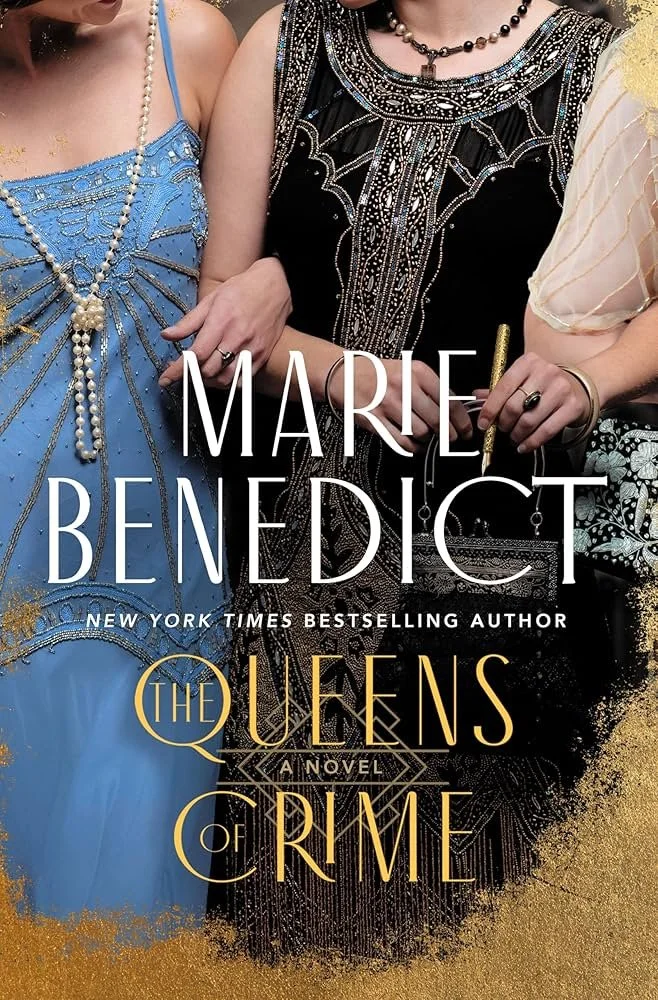
The Queens of Crime
By: Marie Benedict
[Fulfilled ‘A book with a queen’ prompt as part of Shelf Reflection’s 2025 Reading Challenge]
[On my list of Most Anticipated Books of 2025]
“I had no idea that the despicable behavior by certain male Detection Club members would spur us into solving actual crimes.”
“‘Never forget that we women aren’t what you call us— witches or crones or madwomen or surplus or nobodies. We are all Queens.’”
This book, set in London in 1930, is a fictional story about historical figures: namely Agatha Christie, Dorothy Sayers, Ngaio Marsh, Margery Allingham, and Baroness Emma Orczy. All five women were crime writers in their own right and were part of the Detection Club, created by Sayers.
The club is real, the characters are real, but the plot of the story is fiction.
(Fun fact: G.K. Chesterton—Gilbert— was the first president of the club.)
This was a cozy mystery for me. Not one that was particularly hard to solve or suspenseful in writing. I was most interested in imagining writers of mystery novels using their own skills or knowledge and solving a real life mystery. I was also interested in Sayers’ and Christie’s actual lives. Unfortunately, the execution was a little drab for what I was expecting.
(I am not familiar with Marsh, Allingham, or Orczy but maybe I’ll have to find something they wrote.)
But if you love a good ‘women power’ story, you might enjoy this. More on that later.
These authors were working during the ‘Golden Age’ of detective fiction. There are some modern writers who have attempted to mimic this style, including Benjamin Stevenson, Tom Mead, or Charles Finch.
The oath they take as part of the Detection Club suggests some of the rules they abide by in writing their mysteries:
“I vow that the detectives I create will actually detect the crimes and mysteries presented to them using the intellect I grant to them, and I will not allow those detectives to use hocus-pocus, trickeries, superstitions, epiphanies, acts of God, skullduggeries, or divine intervention. All detectives will use fair play in solving their mysteries.”
The Detection Club was started to try to increase support and validity for mystery novels:
“Above all, I hope the rites inspired members to extol one another’s talents, support one another’s novels, collaborate on books, and elevate our genre so reviewers see that our detective novels are every bit as good as so-called literary fiction.”
So why are these five women solving a real mystery?
Well a big theme of this book is the view of women vs men during this time period. Sayers wanted more women in the Detection Club, so she went off on her own to gather some other female authors to join without having it approved by the other members. The women just show up to the meeting and take the oath.
They aren’t welcomed in with open arms, though, and feel ostracized from the group because they are women.
In an effort to prove themselves worthy of being in the group, Sayers thinks they should try to solve a real crime.
“No one would dare slight us or question our place in the club then.”
The case at hand is about a missing nurse— May Daniels— whose body was just found in Boulogne, France. Her disappearance was somewhat of a locked room mystery— she went into the bathroom at a train station and never came out.
Dorothy’s husband, Mac Fleming, is a journalist and is sent to cover the story. Dorothy tags along and the other Queens (as they call themselves) discreetly meet her there. Together they do their own investigation and sleuthing, trying to figure out what happened and get justice for May.
The five women have distinct characteristics that are usually emphasized by their clothing throughout the book:
“Emma, our stately matriarch… Ngaio in her wide-legged pantsuit and Margery in a flowery frock… Agatha sits alone in the upholstered chair to my right, hiding her strength behind frumpiness as always…”
I agree with some other reviewers that said they would have liked less information about food and dress and more depth to the women’s intellect and who they were as people. I was intrigued by the New Zealander but come away just thinking she really liked pants.
May’s body was found with a syringe and all the journalists— including Mac— and police officers (who are men) are tainting her name, accepting that it was some sort of drug deal gone wrong. She is depicted as a loose, unsavory kind of woman.
“‘So missing young women are either labeled surplus and disregarded or labeled whores and disregarded?’”
In this time period, so many men had died in WWI that the prospects for marrying were slim for women. These single women were called “surplus” and looked down upon.
“a young woman attempting to earn a living in a society that frowns upon unmarried working females, even when the dearth of men makes finding a husband nearly impossible.”
“The terrible injustice done to May unfolds before me. Anger and anguish course through me in equal measure, and I will not allow her to go unavenged. Like so many other women who’ve gone before her. Like me.”
And so the book is the story of how they sleuth their way to get justice for May and deem themselves worthy of being in the male-dominated Detection Club.
The side plot of the story is that Dorothy keeps referring to her secret and her shame.
“Mac knows all my secrets. Even the one I am determined to keep hidden from all others forever.”
If you are familiar with her life you probably already know what it is, but I wasn’t so that was a part that I was waiting to be revealed.
Now I am pro-women. I know how smart and capable women are. I also cheer the feminism that enabled women to support themselves and to vote, and to be looked at as equal to men in their standing and their intellect. In history past women have been disregarded and taken advantage of with little to no recourse.
We have come a long way and I am glad for that.
I enjoy reading stories of women who did great things or who may have been overlooked. And I respect the uphill battle people like Sayers and Christie had in their careers. But I’m not really a fan of books that have a man-hating vibe.
I know there were many terrible men that did many terrible things. And they should have to answer for them. But a lot of times books that set to expose that do no counterbalancing of decent men.
In this book, there were no noble men. All the men in power were doing a terrible job and belittling women. The other men were depicted as clueless or bumbling or ‘boys’ club’ men. Even Dorothy says this of her own husband:
“How could a man who supports my career, a man who has daughters of his own, harbor such shameful and antiquated views of a young woman?”
Here are a few more quotes that on their own, I have no problem with, but taken altogether throughout the book feel a bit heavy-handed:
“Perhaps Emma was correct when she pronounced that May’s murder needed to be solved by women, in part because only female sleuths properly credit female witnesses.”
“Headlines like ‘THE SUPERFLUOUS WOMEN ARE A DISASTER TO THE HUMAN RACE’ routinely run in newspapers such as the Daily Mail…”
“The male members of the Detection Club would certainly not deprive themselves for a second: in fact, I doubt they’d make themselves uncomfortable in any way”
“‘Men are so often put on a pedestal, and women are taught to prop them up there. But we only learn about our humanity and develop empathy from our mistakes— and we could do with more doses of humanity, here and elsewhere.’”
I think what puts me off with these books is not so much that I think they are untrue (though I believe there have always been decent men in history) or because I don’t think women like May need justice (they absolutely do!) but more so that in contrast to first wave feminism, modern feminism is not something I champion in the ways our current culture is promoting. It’s no longer about making women ‘equal’ in worth to men but in trying to raise women as superior and above men by tearing men down.
Even though this book is historical and in a time period where women were disregarded or viewed shamefully as superfluous, the vibe that I felt reading it seemed more in line with modern feminism. I think we can elevate women to where men are without tearing men (as an entire group) down.
There’s more to be said on that because I’m approaching this topic with a biblical worldview that I know is controversial to modern ears, but I won’t get into it.
I’m merely trying to iterate why this aspect of the book hit different for me than it probably does for a lot of other readers. And that could very well just be a personal thing and nothing necessarily wrong with the story. I just would have liked to see more decent men depicted in contrast. Even G.K. Chesterton was not really written as a man open to the woman’s plight but more as just cluelessly falling in line with what Sayers was doing with the club—which gave me pause. I don’t know enough about his personality and character but is that even accurate?
So anyway— that would be my main critique.
Moving on to more fun things.
If you want to take in the ‘sites’ of the book: The Vole Hole is still a restaurant in the oldest building of Boulogne and Simpson’s in the Strand is set to reopen this month! (It closed in 2020 due to Covid)
I had the pleasure of googling what a Ner-A-Car looked like and finding out it was named after Carl A. Neracher which was a pun on his last name and the phrase ‘nearly a car.’ Which is amazing.
I’m becoming more and more familiar with British slang and older vernacular for things, but this book threw me for a loop with this one:
“I ignore the dog’s breakfast I’ve made of the flat.”
Hahahaha. Why did we (I’m British now) stop using this? Dog’s breakfast means a total mess. My house is a dog’s breakfast all the time. Why do I just think of vomit?
Many of the characters’ books were mentioned throughout the book, including Peril at End House and Have His Carcase. I read online that The Nine Tailors was one of Sayers’ standout novels if you want to get a taste of her reading.
I had heard of Dorothy Sayers in a Christian context so I was surprised to find her connection to Agatha Christie, just as I had with G.K. Chesterton.
In my side research I found that Dorothy Sayers stopped writing detective novels after 1939 and did mostly religious dramas and nonfiction. She spent years translating Dante’s Inferno into English. She was also friends with C.S. Lewis, as was Chesterton. In fact, C.S. Lewis credits Chesterton’s The Everlasting Man for his conversion. calling it the best defense of the faith he knew.
I would have liked an Author’s Note at the end that tells what parts were true and where she embellished. Based on some other reviews, it’s probably because I read an ARC and it looks like the published version has that.
Recommendation
This wasn’t a book that necessarily sticks out as a favorite or a must-read by any means. But if you really enjoy historical fiction, cozy mysteries, and female empowerment stories this would be a great fit for you.
I enjoyed stepping into the lives of these five women; it seems Benedict did a lot of research to incorporate historical facts about their lives and their personalities. I also liked that it spurred me to look things up and see the setting and understand the historical context, etc.
I think the simplicity of the mystery, the shallowness in the characters we came to see, and the somewhat heavy-handedness of the women vs. men theme made this less riveting for me personally.
I had planned to read The Personal Librarian by Marie Benedict at some point and am now rethinking if I take the time for that or not.
This is one of those books that I’m like— not my fav, but others might enjoy it. There are plenty of positive reviews of this one, just depends what you’re looking for.
[Content Advisory: No swearing; mention of rape and miscarriage but no details described]
**Received a copy via NetGalley in exchange for an honest review**
You can order a copy of this book using my affiliate link below.
Share this book review to your social media!