The Redeemed Reader
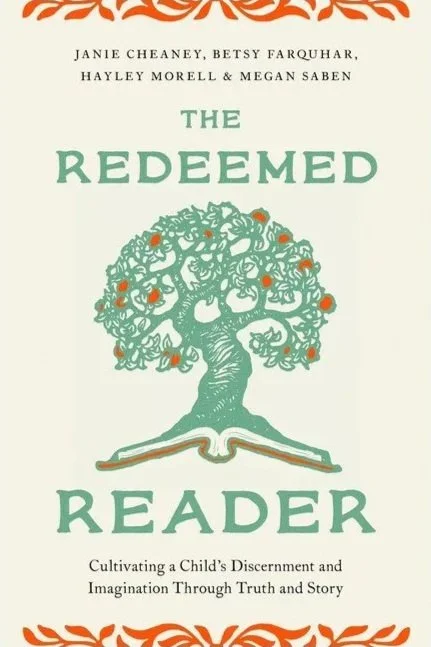
The Redeemed Reader: Cultivating a Child’s Discernment and Imagination Through Truth and Story
By: Janie Cheaney, Betsy Farquhar, Hayley Morell, & Megan Saben
“When we acknowledge and praise what is good and true and beautiful in a literary work, we are shining a gospel light on both Christian and secular authors. We can rejoice in the common grace present in the work of any author or illustrator. This is a wonderful witness and encouragement to authors, both saved and unsaved.”
All the stars for this one!
This book is an amazing resource for the busy parent who doesn’t have time to read everything their kids are reading and wants to make sure that their children’s imaginations are tapped and encountering truth!
The Redeemed Reader is first and foremost a website doing for kids books what I’m seeking to do with my own book reviews: help readers make good choices about what they’re reading. Their team of reviewers provides insights on a broad spectrum of books from classics to picture books to easy readers, YA novels, nonfiction, and more.
They approach their reviews from a biblical perspective: “Not, This art is actually kinda Christian, but rather, Here’s what I realized as a Christian encountering this art.”
Their website is great, but I’m glad they chose to publish this book as well. Not only do they tackle every genre of books and offer booklists at the end of every chapter, but they talk about how to develop discernment in your kids and provide good questions to ask them while they’re reading.
“Anywhere we read of goodness, hope, light, loving one’s neighbor, good triumphing over evil, forgiveness and redemption, healthy family relationships, friendships, and beauty and order in creation, we see Truth, and our hearts rejoice.
Books that hold the most Truth not only show that we need a savior, but that there is a Savior, and therefore we have hope. They point to our deep desire for peace with God and with one another.”
They acknowledge that these themes don’t just show up in Christian labeled books but that we can find threads of the capital T Truth (God’s Word) and capital S Story (grand biblical story of creation, fall, redemption, restoration) in lots of secular works. I’ve found that to be true as well.
At The Redeemed Reader, their goal is to help train children to pick up a book and enjoy what they’re reading while still discerning truth.
“Good stories keep the soul awake, forewarning it of danger and populating it with heroes and heroines whose examples of courage and character give us strength to see ourselves standing against similar foes and refusing to yield to evil. Story has always been and remains our greatest tool in crafting wise and great people.”
I love the heart behind their work as well as the outcome. I am wary of all the book options available to my third grade speed-reader— I can’t read everything she’s reading and still have time to read myself. I love that I can look things up on their website or offer her books from their curated book lists (with all kinds of categories) and know that what she is putting in her mind tells the story of reality, even if it’s the fallenness of the human condition, and that there is hope and redemption in the end.
“We can disagree with the characters’ conclusions and evaluate their personal choices. We can debate whether they understand the reality they’re living in. We can try to discern what the author believes about free will and personal responsibility and human nature. Good literature allows readers to get inside another person’s mind and understand the world from another point of view.
By entering the story, readers gain sympathy for a well-written fictional character, even as they learn to recognize the flaws in their reasoning and choices.”
One of the big takeaways for me was how they recommended readers handle ‘messy books.’ In short, these are books that deal with sin and might make readers uncomfortable.
“books that honestly reflect the human condition are often messy because sin is messy.”
They don’t want us to categorically avoid these books because we are not called to be comfortable, but to be discerning— which is a concept I really agree with.
I loved their evaluation system for messy books. They give a list of ‘P’s’ to ponder when determining if a book is right for your child (or yourself):
Plot Point vs Political Point: “Is the objectionable (or problematic, or messy) content in the book necessary to drive the story, or is there a clear agenda driving the inclusion of this content?”
Pleasure or Pain?: “Does the story also show repentance, disgust at sin, or the negative consequences of sin? Or is the sinful act/thought seen to be only pleasurable or desirable?”
Preparation: “Is the audience prepared for the content, both developmentally and experientially?”
Proportion: “What is the proportion of messy content to the rest of the book? One throwaway line about a character’s two moms requires a different response than a book in which the protagonist comes out as a lesbian.”
Pandering: “Is the author simply pandering to a childish audience… to today’s publishing trends rather than to add depth?”
Protagonist: “Is the protagonist promoting or celebrating unbiblical behavior and beliefs with no evidence of repentance or maturation, or is the villain the renegade?”
Promise: “Explicitly or implicitly, is the story promising redemption and rescue from sin? Or is it promising rewards for sin?”
Problematic or Productive: “Productive messy books illustrate biblical traits like compassion, truth-telling, and repentance. Problematic books do not… [and] present unbiblical lifestyles as normal and acceptable.”
They do a great job of being careful in their recommendations and how they offer them. It is not a formulaic science based on a child’s age. Discernment takes thought, consideration, prayer, and most importantly time in God’s Word to develop. Not all the books they recommend will be right for your family; this is (appropriately) not a copy and paste system.
After they discuss messy books they looked at several contemporary issues that come up in literature that we need to know how to handle, including racism, environmentalism, diversity and sexuality, identity, and dystopian themes.
I wasn’t surprised that these are popular topics, but I think reading their discussion about them made me realize how subtly and easily the corresponding underlying beliefs about God, his world, and his people these worldviews require can be inserted into a story.
They were very thoughtful in their communication about how these show up in books, what questions to ask, and why it matters that we think about it.
The next section of chapters goes through specific genres and what to look for or avoid in each one. The genres they cover are picture books, easy readers, humor, poetry, sci-fi and dystopia, fantasy, and romance.
A couple thoughts that stuck out to me were:
help your children pick their ‘book friends’ like they would pick their real-life friends— it might be time to break off with a book or series if the main character isn’t showing characteristics you would want in a real friend
“Think of poetry like cinnamon: no one wants to eat cinnamon plain, but no one wants to eat pumpkin bread, apple pie, or a cinnamon roll without it!”
a good question that science fiction often explores in some way is- ‘Am I becoming more like my machine? Or more like Christ?’
“It’s important to nudge our kids toward healthier romantic reading and never leave the impression that romantic love conquers all, justifies all, and lasts forever. Only one kind of love does that.”
The last few chapters are for practical application.
They offer guidance in finding the right Bibles for your kids. Their recommendations were ones we’ve already been using with our kids and recommending to others as well! (The Beginner’s Gospel Story Bible, The Biggest Story Bible, The Ology, The Kingdom and the King Storybook Bible)
They talk about how we can encourage authors, secular and Christian; how we can love on our libraries by requesting good books and checking them out; how we can use books to help us understand things happening in the news; and how we can curate our own libraries at home.
I love public libraries and it was a good reminder that we alert our libraries to what we are interested in and want to read more of by checking books out. They take note of what is in circulation so help make your library better by checking out the good books!
That last one about home libraries was particularly helpful for me because I’m about to have a new bookshelf built in my house and I’m preparing to inventory all my books and make a system to let people in my life check them out! They had some great ideas for how to decide what books to donate or keep and offered some suggestions for books to make sure you have for members in your family.
“The goal of managing a home library is to bless your family and friends and to encourage them to explore and use it. The purpose is not to have every title you could possibly ever want, nor to have every book always readily available, but simply to be able to find it.”
If you want to browse their book reviews on their website, look for the *starred books because these are the ones they recommend without caveats or considerations (other than age considerations). Other books are still recommended but they offer some insight on what to be aware of before picking it out for your specific child.
You can browse their site by age group, genre, subject, special topic, and over 175 curated booklists like ‘recommended graphic novels’, ‘books for young horse lovers’, ‘for 16-year-old girls’, ‘family read alouds’ etc.
They also have a way to contact them if you would like a book reviewed that isn’t on their website.
[Many of the books they’ve recommended I’d already included on my Kids’ Shelf page.]
Lastly, though perhaps I should have put this at the beginning of the review:
“Remember, the only required book is the Bible. May you never be too busy to read it. Our booklists are recommendations, not requirements.”
Recommendation
I think this would be a great book to add to your personal library if you can. If you can’t, at least bookmark their website as an easy reference when you’re looking for and monitoring books for your kids.
Kids’ imaginations are wonderful, but also very impressionable— we have a responsibility to engage them and allow them to think about hard things, but also protect them from things they aren’t ready to read yet.
The Redeemed Reader is a fantastic resource to guide us as parents, guardians, or librarians with the children in our care, directing them to what is good, true, and beautiful— to what points to Truth and echoes the greatest Story of all.
Definitely read this book and check out all that The Redeemed Reader has to offer! I know I'm going to be telling people about this all the time!
**Received a digital copy of this book from Moody Publishers**
You can order a copy of this book using my affiliate link below.
Share this book review to your social media!