Twenty Something Else
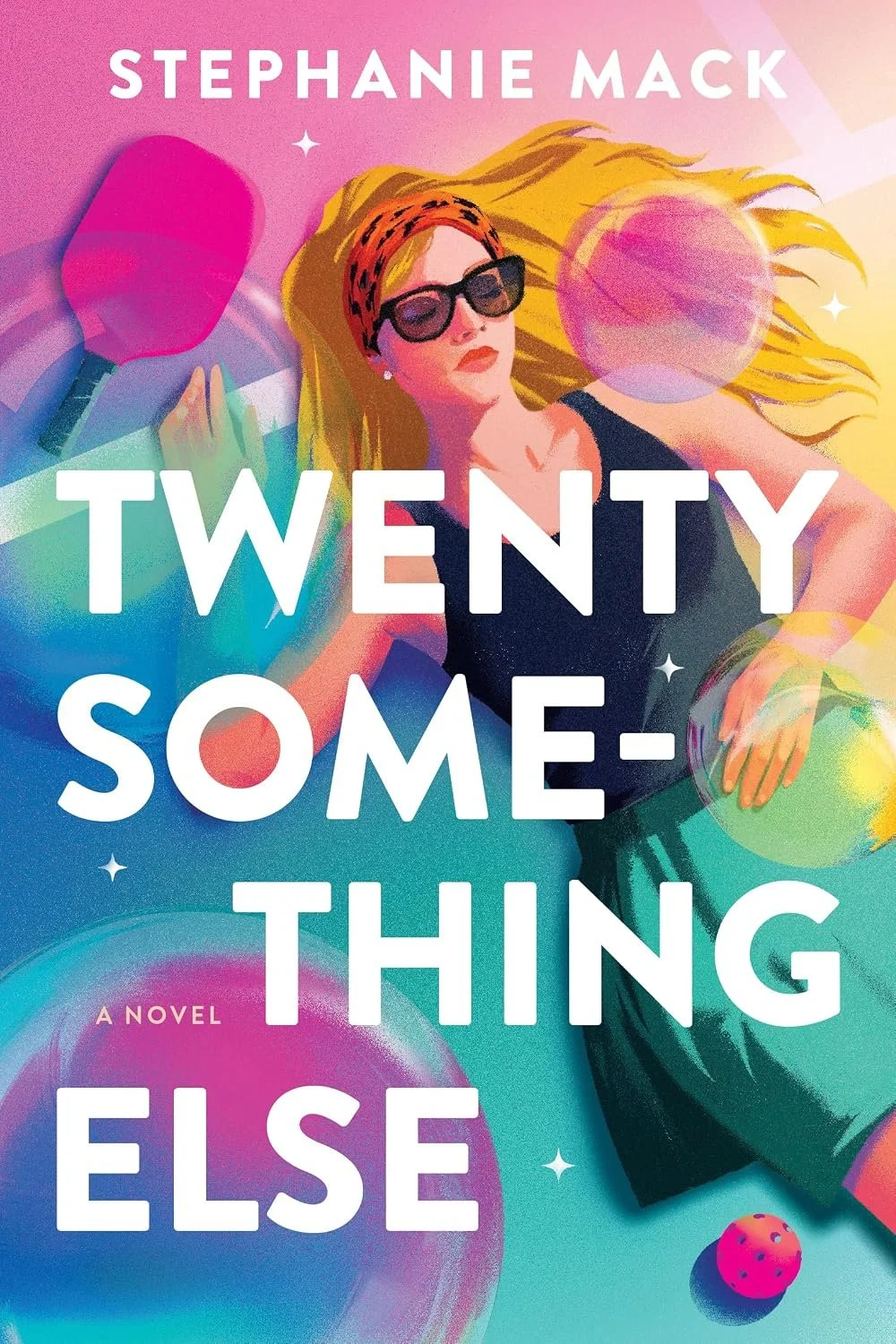
Twenty Something Else
By: Stephanie Mack
“Some things extra guac cannot fix.”
This was a lovely and relatable story.
I mean who hasn’t gotten smashed in the face with a pink pickleball that sends them on a time traveling quest back to their twenties in alternate universes to see if they’d rather have a different life??
I am not yet forty, as our main character, Sutton, is just turning, but I have entered my late thirties and am raising four children in a world where aging is seen as a disease to be cured, motherhood depicted as the graveyard of untapped dreams.
I feel the cultural pressure to be young, to see motherhood as a hindrance to ‘following my dreams’ as if my children aren’t the dream. I’ve gone through hard seasons in my marriage as we’ve added each child and had to figure out how to still prioritize each other. I have felt the weariness and my husband and I have reminisced about our younger years.
As Sutton nears her 40th, she laments:
“‘Since when is it a knock against you to be a MOM?’… I might as well be wearing an expiration date like a scarlet letter…
I’m still something, aren’t I?…
…If my choices have been so wonderful, then why am I weary and worn?… I want to be sitting here fully confident in my kids’ love for me, gratified in my accomplishments, satisfied in my marriage. Instead I’m wondering where I might’ve gone wrong. Could there have been other choices or versions of me, ones that led to more contentment and peace? Happiness?”
I think everyone wonders this at some point.
The concept of this story is not original. The writer intentionally wrote her own version of It’s A Wonderful Life— her favorite movie— with the suburban mom twist and I thoroughly enjoyed the ride! (It also felt reminiscent of the rom-com movies About Time and When We First Met).
In an interview (I found online), Stephanie Mack shares part of what was behind this story:
“Even when our dreams have come true, they can feel different than we pictured. That tension is ripe for what-if reflection, not out of regret, but curiosity and meaning-making. We’re a deeply nostalgic bunch. We’re also old enough to have lived several versions of ourselves, yet young enough to still feel the weight of choice. Looking back becomes a way of understanding what truly mattered, what shaped us, and how to carry that wisdom forward.”
While I didn’t fully relate to Sutton’s life— because I live in Iowa and not California and I don’t like coffee, use Instagram, do Botox, or wear make-up— we did have commonalities in having March birthdays, being a mom of twins, having a husband in finance and a friend who taught in a Central American country, marrying at 22 (21 for me) and having kids at 26, playing pickleball, and loving our college years.
It’s intriguing to think— what if I had made a different choice? What would the trajectory of my life had been?
Sutton gets a facial from a pickleball the night before her 40th and wakes up in some sort of limbo with some sort of angel— this isn’t supposed to be straight out of the Bible, folks— and a balloon marked with each year of Sutton’s twenties.
“‘Your unsettled spirit brought you here. You can only go back if you are certain that your old life is what you want.’”
By popping a balloon she enters into this alternate reality where she made different choices. She can see what could have been.
“‘Everyone has roads not taken. Lives not lived, other selves they could have been. You, for instance, chose to marry Reid at twenty-two, become a mother at twenty-six, and follow that wonderful path, leading you here, to your fortieth birthday… Of all the critical decision points and forks in the road of becoming Sutton, this is the one that most powerfully influenced your twenties and future decades.’”
Armed, now, with a pink pickleball that in some ways acts like Dorothy’s red shoes, if she holds it and counts down from 20 she goes back to the limbo place where she can try to assimilate into a different year.
“Benjamin Sutton. Doing time backward.”
Mack shares:
“Twenty Something Else poured out of a very real season of reflection—standing at a milestone as a suburban mother of three who married her college sweetheart nearly twenty years ago, and wondering how the past, the present, and the person I once was all connect.”
With humor and vulnerability this book was hard to put down!
Perhaps her life is more Classic California than mine is but even in the a Midwest without palm trees, women still feel similar pressures and are faced with the same decisions about joining a trend or not.
The messages in this book are good— I wasn’t sure how it was all going to shake out, but I was happy with what the characters learned and what ultimately was prioritized. The storytelling was compelling and entertaining. There was grace while not leaving out the wisdom. Though not a completely original concept, well done nonetheless.
Reading it while traveling added to the overall experience. I was looking at a Delta flying booklet on my own flight when Sutton traveled via Delta to the Matterhorn. There was a 2000s playlist going in the airport when our flight was delayed six hours that took me back to my highschool and college years. It had a great combination of modern and nostalgic references.
I loved the emphasis on female friendship because women need other women who understand the pressure and the struggle and can offer support and encouragement. What a gift to have friends who can pray over you! Too many books portray competitive friendship, fake friendship, or conditional friendship. It’s refreshing to see genuine care.
This book isn’t trying to be unpredictable so I don’t think I’m really spoiling anything by sharing this, but I was glad that Sutton remained true to her family.
I was also worried that she was going to choose her family but that she was going to convince her friend (who was having marital problems in the real timeline) to not marry who she married.
It would have been contradictory that they could both be struggling and one of them learns grace, contentment, and intentionality, and the other one gets the exit path.
I’m also glad that the answer wasn’t just ‘I guess I am happy after all’ but that she recognized how fulfilling her family is, how important her role, recognized areas she can love her husband better, recognized what she’d lose if she’d chosen different.
“The sanctified feeling of family… Crowded and messy and pressing up into my personal space. Hovering, needing, and taking. Loving, knowing, and holding. Stealing my time. Stealing my heart. But giving me everything, multiples more than they could ever subtract if they tried.”
Marriage does take work and intentionality; it’s not always easy. And just because it’s hard doesn’t mean it’s over or it’s not worth it.
I often look at pictures of my husband and myself when we were first married and I understand Sutton’s sentiment: “I want to reclaim the optimism, wonder, and passion of those years in our twenties— the belief that the world can be changed. That great love exists, even if it evolves.”
There is something beautiful about that wonder. At the same time, I wouldn’t go back there. That earlier version of me was untested. Carefree but untouched yet by the depth of life.
My husband and I have weathered some stuff. We’re different now. But we’ve gained wisdom; we’ve been tested; we’ve grown. And that’s a good thing. It strengthened our bond and prepares us for future hardship. It’s a life that pushed us deeper into the love of our Creator and Savior.
We’re meant to be weathered people. We’re meant to share in the sufferings of Christ.
If you don’t feel content in your life right now, you don’t have the option to visit alternate realities, but know that the Lord’s plan for you is the best plan. He has you where you are for a reason. Seek Him first and contentment will be close behind because he is all we need. He makes the hard times endurable. He offers hope for transformation and ultimately hope for life after death where all is made right.
The wonder can be reclaimed by housing it under the umbrella of God working in our lives for our good and his glory. There are still endless possibilities because we serve a sovereign God.
Negative Reviews?
I was surprised to see as many reviews as I did that were disappointed by the book. There were some that found the book too shallow. Some who took issue with Sutton’s interaction with the male figures in the past. Some who thought the whole concept as a whole of going back and changing the past was unbiblical.
I’d like to offer my own opinion on these things as someone who really enjoyed the story but can see where all of them are coming from.
To the critique of ‘superficiality’ I would argue that I believe women everywhere struggle with the things Sutton is struggling with, superficial as you could argue them to be. They are real questions we ask ourselves, especially if we are ‘aging’ moms. At least in America where the pressure to look a certain way are blasted everywhere and we’re supposed to ‘follow our dreams’ and being mother surely can’t be one of them.
No matter how ‘good’ or ‘not good’ we have it, one of the devil’s most effective tools is whispering ‘discontent’ into our ears. The what ifs. The ‘isn’t there something better somewhere else?’ The ‘isn’t God holding out on you?’
There are a lot of superficial things out there clamoring for our attention, especially as women, and depending where you live and what you’re surrounded by, it takes will power to not get sucked into it all, even though you know just how superficial it is!
In that way, the superficiality is the deep thing because maybe we think we’re immune to it but we’re really not.
True, there are a lot of comments about beauty and appearances. I don’t own make-up and I have zero skin care routine but I can’t say I’ve never wondered if I’m missing something. There can be pride in keeping up our appearances and there can be pride in feeling superior to all the women who DO do those things. That’s why I appreciated the message of grace in this story, that we’re all out here trying our best. We should be encouragers, not tearing one another down with harsh judgments as if we have never cared about our appearance before.
To the critique of whether the concept is biblical or not…. no, it’s not biblical. But it’s not trying to portray itself as a doctrine. It’s very clearly a magical realism type of book. We all know you can’t go back in time. We all know that’s not even a choice we can make or not make. It’s fiction.
Stephanie Mack took a popular time travel trope that explores a curiosity to inspire self-reflection on our own discontentment in our lives. To come away thinking— but God doesn’t offer this to us!— I think, is missing the point. But truly, if that feels like it’s kicking at your conscience, by all means, pass on this book. It is far from required reading!
And if you happen to be a reader that is wondering if time travel actually is a way God works, I can clear that up for you so you can enjoy the divergence from reality: no. God doesn’t deal in time travel. He is outside of time, but we are very much within time. We can’t go back and change the past, but just as the author describes in this story, we can be forgiven for the past and that changes the trajectory of our future.
Probably the biggest critique and the one that is probably the most well-founded is the way Sutton interacts with men in these alternate universes. Isn’t she still married? Isn’t it cheating?
I do think that Mack does a good job of showing that Sutton is very conflicted about how to handle these other ‘relationships’ she finds herself in by entering into this ‘other reality.’ She asks questions about what is okay or not okay. She is told by the angel that her ‘real life’ doesn’t exist here. Reid and her children don’t exist at that point. Does that mean she’s not married and it doesn’t matter or is she still married in her heart? I don’t know.
Alternate universes aren’t real. It’s one of those weird things to grasp when time traveling. It’s not a perfect system and things get tricky when figuring out the moral boundaries because it’s all a fictional scenario.
I believe Sutton understands and exercises wisdom in a lot of ways. She holds hands and kisses (which, yes, is still cheating) but compared to what a lot of secular books would do, it’s mild.
Again, if you have personal convictions that poke at you that you shouldn’t be reading that, then pass on the book. For others, I didn’t find anything categorically problematic with the way Mack handled this in the story. It just felt like the package deal when it comes to entering into your own alternate realities.
I didn’t feel like Mack was even trying to send the message that it was okay for Sutton to do it. I didn’t think it was glorified or made to seem like an awesome thing. The overarching message was that Sutton was realizing how much she loved what she already had and that these lives weren’t for her. I don’t think readers would come away thinking— ‘If only I could go to an alternate universe to mess around with other men because it doesn’t count!’ That was not the vibe I got while reading.
There was one scene where Sutton shares with Reid before they were married that she was not a virgin. She recalls a youth group thing about purity that made her feel like used and damaged goods because of her choices. I’m glad that Mack inserted the message that the intention behind that illustration was good but incomplete. There is forgiveness for sin and there is cleansing of sin. God is in the business of making new creations.
For a nonfiction look at the conversation of purity I would recommend Talking Back to Purity Culture by Rachel Joy Welcher or What Gd Has to Say about Our Bodies by Sam Allberry.
“You are a precious image bearer of God. Your purity has already been won for you in Christ, and your dedication to pursuing sexual purity is not defined by your virginity but by your surrender to Christ and dependence on the Holy Spirit today. Today is a new day to pursue sexual purity out of love for the God who rescued you and brought you safely to himself in Christ.” — Rachel Welcher
Recommendation
I would definitely recommend this book! I think it’s a fun, nostalgic, and relatable book, especially for women in their thirties and forties who are feeling the cultural pressures of anti-aging or the downplaying of motherhood.
Stephanie Mack chose a specific type of book to write with the ‘magic’ of time travel and a reflection of discontentment and I thought she excelled at it.
Even for women who don’t relate to every part of Sutton’s life, I hope readers can connect to the overarching theme of the book and not come away judging Sutton’s life. If she were a real person she would be a sister in Christ and the message of the book is grace, contentment, friendship, and perseverance (and not trusting a guy in a leather vest).
Women tend to tear down when they need to feel better about themselves. I hope this book can remind readers that we’re all out here trying to do our best and encouragement from a friend goes a long way!
I would also recommend reading Jen Wilkin’s book Dust to Dust: Aging Wisely in an Anti-Aging World alongside or after this one. Clearly this is a relevant topic for people today and I believe her nonfiction book will offer even further biblical guidance on stewarding our time and our bodies.
**Received an ARC via Tyndale Publishing**
You can order a copy of this book using my affiliate link below.
Share this book review to your social media!