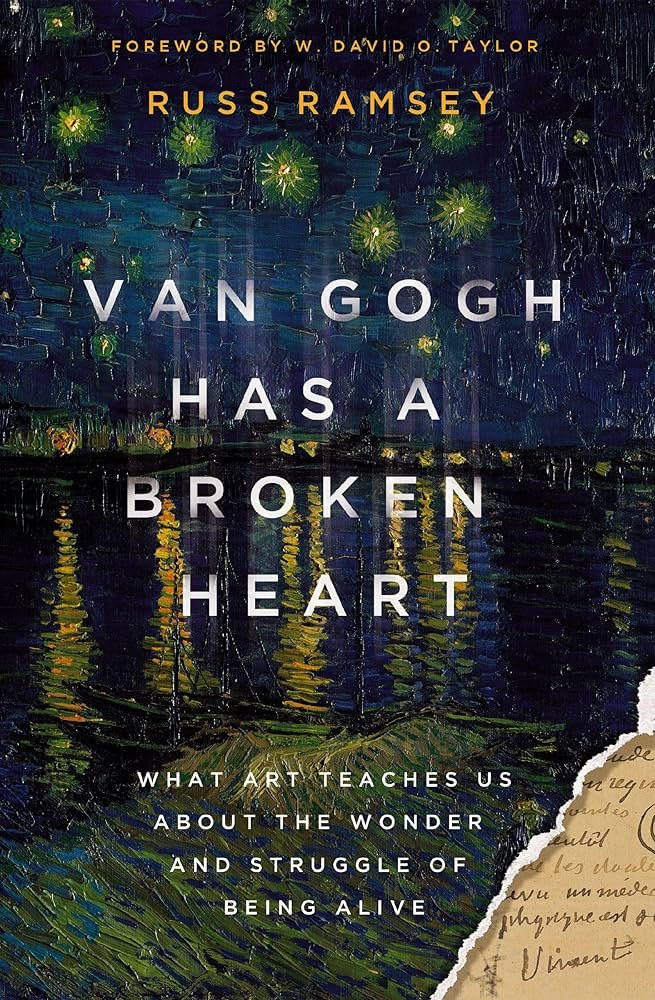
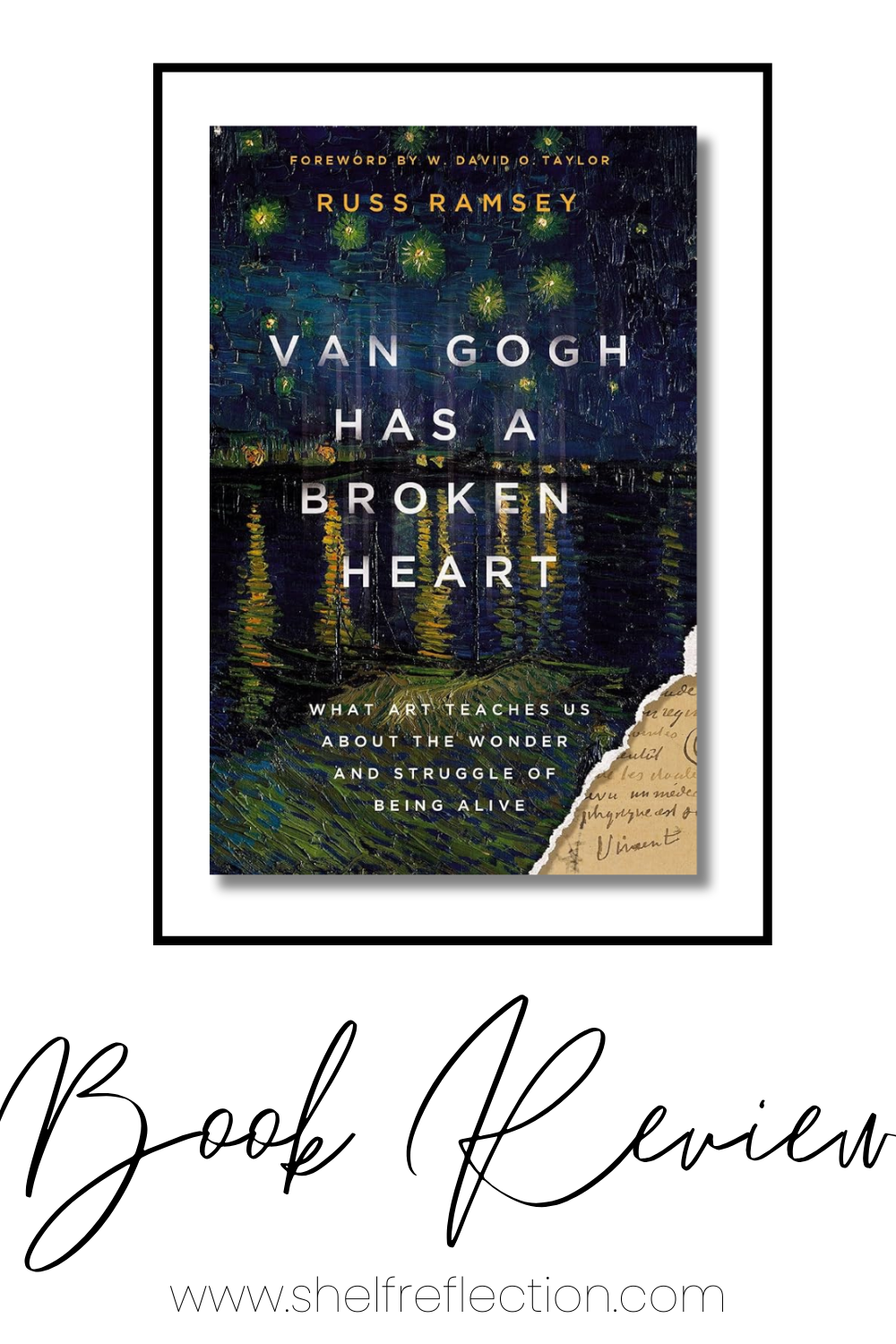
Van Gogh Has a Broken Heart: What Art Teaches Us about the Wonder and Struggle of Being Alive
By: Russ Ramsey
[Fulfilled ‘A book about a historical figure’ prompt as part of Shelf Reflection’s 2025 Reading Challenge]
“If you approach any work of art with curiosity, there will always be something for you to take away.”
“Art makes a statement we can return to when we struggle to find the words. Even in our places of deep lament, hope is there, and art plays a role in stirring that longing.”
I read Russ Ramsey’s Rembrandt is in the Wind back in 2023 and really enjoyed it! Ramsey is really good at making art history interesting. I took several art history classes in college and did not find them interesting or valuable at the time. Ramsey makes me wish I had been able to appreciate it more back then when I had time to study it.
Now having read two of his books I’ve decided I should have just had him teach my classes and it would have stuck with me more! I have also decided that I need to visit an art museum with Ramsey so I can see how he approaches art in practice.
Van Gogh Has a Broken Heart is similar to Rembrandt is in the Wind in the way that he has written it. Each chapter focuses on a different artist, sharing a story or background of the artist or the work and then tying it into some sort of deeper meaning.
I will say that I think it worked better with Rembrandt is in the Wind and I liked that book slightly more than this one. Nonetheless, this book was still an enjoyable read!
The main theme of this book is looking at what these artists or their works tell us about suffering and wonder in the midst of pain. We are warned at the beginning of the book that it is full of sad stories.
Why? Because this “is where much of the world’s art is born— from struggle and sorrow.”
“Art shows us back to ourselves, and the best art doesn’t flinch or look away. Rather, it acknowledges the complexity of struggles like poverty, weariness, and grief while defiantly holding forth beauty—reminding us that beauty is both scarce and everywhere we look.”
Art brings us to the line between glory and sadness.
As I included in my review of the first book, this is a little summary of the artists he talks about and how they fit into this theme:
“We live in a world alive with beauty, but it is filled with suffering too. Some of the beauty is hidden in the pain we come to know in this life…it’s in the stories Rockwell told of a generation reticent to boast in their own heroism at war. It’s in the way Rembrandt held his granddaughter at her baptism—his last connection to his first love. It’s in the secrets Turner kept in his sketchbooks—his inner life concealed from the rest of the world. It’s in sublime wilderness the Hudson River School painters attempted to warn us about. It’s in Vincent’s desire to be accepted by his friend Rachel as he gave her a part of himself. It’s in Jimmy’s fading vision that makes him see this world in a new way.”
What Ramsey is trying to do in this book is to help us find the beauty in the broken.
“So much beauty is born out of suffering. We make some sense of brokenness and pain by looking at the beauty they produce.”
As with Rembrandt is in the Wind, I learned things I had never known before about well-known painters or works. For example, in Van Gogh Has a Broken Heart I learned about how the Mona Lisa didn’t gain popularity until it was stolen from the Louvre and then recovered. (And Pablo Picasso was a suspect!) I learned more context behind Vincent Van Gogh cutting off his own ear. I thought about the importance of nature paintings that inspired colonists to head west into an unforgiving landscape. And I got to put more background to Norman Rockwell whom I’ve only known by name.
I will say that there were chapters I liked more than others. And at times I wondered where Ramsey was going with a particular story. There isn’t always a clear connection until the last few paragraphs of a given chapter.
Similarly to the other book, I sometimes wondered if the connection was as strong as Ramsey was presenting it, but when the conversation is about art and how we might respond to it, it’s more subjective than objective.
As I did with my review of his other book, here are some quotes and ponderings.
(I don’t have book club questions like I wrote for the other review, but if you’re looking for that, this book actually has discussion questions in the back for each chapter— and they’re pretty good.)
“All art comes from somewhere. It comes from someone who is in the process of living the one life they’ve been given. The more we can understand the specifics of their individual experience, the more we will understand why they created what they did and why the world has responded to it in the way we have.”
If appreciating art requires some research on the individual, their era, and their experiences, how can we have success in an art museum? Maybe some pieces provide extra information or guides to explain things, but it seems you wouldn’t have access to the knowledge needed right at that time. You’d have to go home and look stuff up and then you won’t be right in front of the work anymore.
“I want these stories to undermine the intimidation and distance people can sometimes feel when walking into a museum, as though there’s some academic or cultural knowledge you must possess before you could ever hope to appreciate what you see there. Perish the thought. It is a legitimate form of art criticism to stand in front of a painting and say, ‘I like this one,’ and of another, ‘This one, not so much.’”
I appreciated that he stated this so bluntly. He has an appendix about how to differentiate between ‘liking’ and ‘appreciating’ art and gave some tips on what to do if you find yourself not liking a piece of art or an entire style of art. Ramsey would love to bring more people into the art sphere and I think he has written these books to show people art is for everyone, not just the ‘art enlightened.’
“There is something in the human condition that leads us to believe that possessing external things regarded as precious and desired by the world will somehow add to our intrinsic value, even when it costs us dearly.”
This quote came from the chapter on the Mona Lisa and everyone suddenly wanting something they couldn’t have. I thought it was interesting to ponder how that manifests in my own life and the human psychology of this phenomenon.
“We could look at Artemisia’s work and think her intended narrative thread is about the plight of a woman living in a man’s world, which is certainly part of her story. But we must be careful not to romanticize her work to make it fit our own cultural moment. It is one thing to draw conclusions about the impact of her art over time, and quite another to assign intent to her body of work that may not represent how she thought about it.”
I thought this was a good reminder because we do this with other things— including the Bible. We are living in our own cultural moment and viewing things through that lens sometimes assumes motives or intent where we should not.
In the chapter on JMW Turner he talks about deconstruction. That chapter was probably the most disjointed one for me. But I would recommend Alisa Childers’ and Tim Barnett’s book— The Deconstruction of Christianity— if you are interested in exploring or understanding that topic more. I’m not sure Ramsey portrayed it as clearly as he should have.
The chapter about the Hudson River School painters talked about the sublime. In this context it’s the power and majesty of nature. It’s a bit hard to define the sublime, but he says it this way:
“we are pained that we cannot describe or even comprehend the wonder we’re beholding, and we’re aware that this is because there is something in us that is unable to behold the glory in full. Yet at the same time, we are overwhelmed because there is also something in us that suspects we were made to exist in such splendor. This response of pain joined to passion, this holy discontent joined to astonishment, is the power of the sublime.”
I thought this was really interesting to think about because we know that nature is a reflection of its Creator. And when we take in the imposing mountains, the powerful waterfalls, the mind-blowing stars, this kinda explains that jumble of emotions we have and our feeling of being small in the world.
This quote comes from the chapter about Vincent Van Gogh and his ear. I liked that Ramsey was asking readers to stop making jokes about the ear, and to recognize the pain that led to that incident. It is a sobering thing to know another’s pain.
“To really know a person is to know them by their sorrows… To know someone by their pain is to know them by their need… Our sorrows, failures, and afflictions are sacred, not shameful, because they tell the truth about our need for redeeming grace and mercy.”
We don’t often let people into these vulnerable parts of our lives. We don’t want people to see our need and our failures. But when we share these things, we’re telling a gospel truth. And we can point to the One who rescues us.
This quote comes from the last chapter, which I think was one of my favorites:
“Think about the physiology of growing old. If the Lord grants us many years, the way to eternal glory will include the dimming of our vision, the slowing of our bodies, the dulling of our minds, and the diminishing of our appetites. It’s a path that requires us to loosen our grip on this world, preparing us to leave it before we leave it. Is this not mercy? Is there not an art to this?”
It’s often asked why it hurts so much to get old. Why do we have to go through the slow deterioration of what once was. I had never thought about it the way Ramsey describes here, but it makes perfect sense. Sometimes God allows us to experience things that require us to loosen our grip on the current world and to prepare us for the next one. As Ramsey likened his role in ministry— preparing people to die. It sounds morbid but it’s not really when you think about the glory that awaits. We lose sight of eternity and it’s a mercy when God calls us back to refocus our vision and prepare ourselves for it.
It was profound to me when Ramsey talked about the book of Lamentations, written by the weeping prophet, Jeremiah. I didn’t realize the poetic complexities of that book. It made me want to study it more. I really liked this quote that references that situation:
“In Judah’s worst moments, the words the Lord gave to call them to repentance and restoration were filled with beauty and artistry. The prophet didn’t just say, ‘The steadfast love of the Lord never ceases…’ He said it in a pair of acrostic triads… They aren’t just words. They are chosen words, crafted words, ordered words, risen words.”
Sometimes the logical and practical parts of my brain rule my life and I wonder what place art has in the world. It’s always good to be reminded how God was the first artist and His Word intentionally has poetry. Even in the darkest parts of history, art can call us back to truth.
I’ve read several books on pain and suffering. I think sometimes we delude ourselves into thinking we might avoid hardship and suffering, but it always finds us. Instead of being surprised or frustrated by it, we can prepare ourselves for it. Expect it. If there is one common thread through almost any book on suffering it’s that it grows a person and makes them stronger.
“To suffer well is not to have our faith shattered but rather to have it strengthened because, through it, the object of our confidence becomes clearer and more focused. The blessing of suffering is that it strips away any pretense of not needing God or others. It frees us from ‘this exhausting comedy’ of having to pretend that we’re fine on our own.”
“Affliction has the power to quiet the voices in our heads that insist we already know everything. Seeing through our suffering won’t show us a new world, but it will show us more of the world we think we already know. And affliction is bound to find us. When it does, whatever faith we profess, along with all its convictions regarding the meaning of this life and the next, will be tested.”
I think that’s a lot of what Ramsey is saying in this book. Artists are often more willing to sit in the suffering and interact with it. When they create art born from their suffering it offers us another perspective in viewing our own pain. There are many artistic renditions of Christ’s suffering. Jesus told us to take up our cross and follow him. That means pain and suffering are virtually guaranteed. But we’re not doing it alone. And it will open our eyes to more of the world God has made. Things we didn’t know we didn’t know.
Recommendation
Overall, yes I would definitely recommend this book.
However, if you were only going to read one of Russ Ramsey’s books, I would probably read Rembrandt is in the Wind instead of this one.
If you already read his other book and enjoyed it, then I think you will enjoy this one too!
If you haven’t read either and are open to reading more than one, then definitely give this one a try! Especially if you have any interest in art or would like to have an interest in art.
You don’t have to be an artist to enjoy these books, and even if you have no desire to walk through an art museum, I think Ramsey’s books will give you a new perspective on appreciating the art world. (He hasn’t brought up Jackson Pollock yet, though, so it only goes so far! He does like Mark Rothko now so I think I need to see his work in person to see if I get it too, but ANYWAY)
It reads pretty quickly AND there’s color pictures! What a deal!
And Russ Ramsey, if you are reading this and you would like to apprenticize (I think you can make it a verb) me at an art museum to make up for all the art history classes I complained about, I’m game.
You can order a copy of this book using my affiliate link below.
Share this book review to your social media!