
Daughter of the Rebellion
Daughter of the Rebellion
By: Jamie Ogle
[Fulfills the prompt: ‘Book about a historical event that’s not from WWII’ for the Shelf Reflection 2026 Reading Challenge]
[On my list of Most Anticipated Books of 2026]
“‘We trust that right will prevail in the end. It is rarely easy, always costly, but never hopeless.’”
It’s been awhile since I’ve read something set during the Roman empire! I was going to say that was a fun change of scenery but it’s about gladiators and gladiatrixes so fun is not the right word.
This was a fictionalized telling of the historical Telemachus and his influence in ending the gladiatorial games in Rome.
Daughter of the Rebellion is a love story filled with pain, bravery, vulnerability, honor, and heroism. It shows that we can trust God even with our darkest moments.
That “‘Just because something seems impossible doesn’t mean we do nothing.’”
The gladiator system might have touted valor and honor, but it is empty and false because it rejects the dignity of image-bearers. Christianity entreats us to honor God who is the source of both strength and mercy, justice and love. Part of honoring the Lord is honoring his creation— his image-bearers— and treasuring life.
It’s always humbling to think about Christians before me and the persecution they faced (and still face around the world). The Christian life is not an easy one, but it’s the only one with true hope. This book gives us a good example of how to stand and resist what is contrary to God’s design. What a legacy of faith and trust Christian martyrs leave behind!
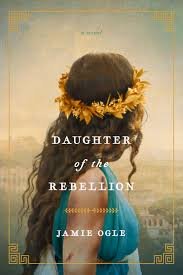
The cover image is a little misleading. Our main character is a female— Adelgard— but she is a prisoner of war sold to a ludus and forced to be a gladiatrix. Pretty much the entire book revolves around that situation. The cover makes it seem like she is living this calm, fancy life when in reality she spends her days in the sand fighting for her life and her honor.
I had never heard of Telemachus before. In my own research it seems we don’t know a lot about it and some stories differ from one another. That’s probably why Ogle opted to imagine her story focused on two other characters— a gladiatrix and a medicus— that knew Telemachus rather than make him the true focal point.
I don’t know if the final publication will include an author’s note at the end that shares which parts of the story were true. I read the advanced readers’ copy and to my chagrin, that version did not. I would love to know what Ogle found in her research! Based on the details of the gladiator life she wove into the story, it’s clear she did a lot of it.
[UPDATE: I have confirmed that the final publication has an author’s note that separates fact from fiction]
It is hard to read about the gladiatorial games because we do know the true history and horror that played out in those arenas; Adelgard’s plight is heartbreaking. Having visited the Colosseum in Rome, it was sobering to look around and imagine people treating violence and death as a form of entertainment.
At the time of Telemachus’ ‘event’ (I won’t say exactly what it is because I feel like that’s a spoiler) Rome was ruled by young Emperor Honorius who was recognized as a Christian. At this point in history Christianity was the established state religion. Telemachus is appalled that Christians would still be allowing, promoting, and enjoying the despicable practice of the games and was urging the emperor to stop them.
In the story Adelgard is a Visigoth, a people group from the Balkans ruled by Alaric at the time. Though, historically, Alaric was responsible for the sack of Rome in 410, Ogle used his animosity a little differently in the story and the timeline is different. I’m guessing this is fiction, but in the book Alaric is threatening to attack Rome if the emperor does not release his people who were captured, including his own wife and daughters.
Telemachus tries to press upon this information and persuade Honorius to meet Alaric’s demands. In this story Telemachus, a monk from the East who spent time as a gladiator earlier in his life, had been with the Visigoth people teaching them the Scriptures. He knows Adelgard personally and because of his own experience, knows what she’s going through as a gladiator.
Meanwhile Adelgard is telling herself that she doesn’t mind being a gladiatrix. Feeling betrayed during her capture, previously ostracized by her people, and feeling unwanted by her own father, she views her role as a gladiatrix as something purposeful, a way to achieve her own worth.
She thinks she is being taken care of by the Romans, fed and clothed, and because of her fame, loved. No one has ever fought for her before so she is perfectly fine to take her life into her own hands and work her way up to a better life.
“The only way to stop fighting forever was to prove herself worthy and earn a place among the magistri— or die trying. To be unable to even try… That offered a fate worse than death.”
Enter character two: Felix. Felix, schooled as a doctor in Alexandria, left the family business at the ludus because of his Christian beliefs. Now he would do no harm. But when his father disappears after accumulating a big debt, Felix feels forced back to the family business to provide for his mother and sisters. He becomes one of the doctors to the fighters.
This is where he meets Adelgard. And where we get the romance aspect of the book.
Felix becomes close to Adel and cares for her. He eventually teams up with Telemachus and some other monks to try to help Adel and the other captives escape their fate.
“‘I do not know if anyone can survive what is coming. You have given us hope, Felix. And that is a better gift than any I have ever received.’”
Adel unknowingly helps give Felix the courage and strength to do the right thing, and Felix helps Adel know her worth, that not every man will lie to her and take advantage of her:
“‘You, Adelgard, are a woman worth fighting for.’” *cue swoon
Jamie Ogle has written a compelling story that makes you feel like you’re there. Even though it’s a heavy atmosphere, she still manages to include some humor and lightheartedness. I enjoyed Felix’s relationship with his sisters and the banter he shared with Adel.
I loved the themes that explored courage and love and how the characters realized they were both justifying something wrong because they weren’t trusting the Lord for what they needed (Adel justifying her own abuse, calling it love; Felix justifying being part of a murderous organization because he needed provision).
It’s a dark part of history, but Ogle shows us where the light is.
Recommendation
I thought this was a great read, especially if you enjoy historical fiction or books set in the Roman empire.
We might not find ourselves in a Colosseum like Adelgard, but we still must be on our guard against compromising our beliefs for what is popular. We have our own battles to resist the lure of sin, of complacency, of fame, of self-sufficiency. This story reminds us that though our journey is hard and costly, it is never hopeless.
‘The Lord brings the counsel of the nations to nothing; he frustrates the plans of the peoples. The counsel of the Lord stands forever, the plans of his heart to all generations.’ (Psalm 33:10-11)
This was my first Jamie Ogle book, and I’d read another.
[Content Advisory: No swearing or sexual content (there was some sexual harrassment); Many of the fights are described so there is a lot of violence and some death but I wouldn’t say it’s super graphic or gratuitous.]
**Received an ARC via Tyndale House Publishers**
This book releases May, 2026. You can pre-order/order a copy of this book using my affiliate link below.

Share this book review to your social media!