The Cross of Christ
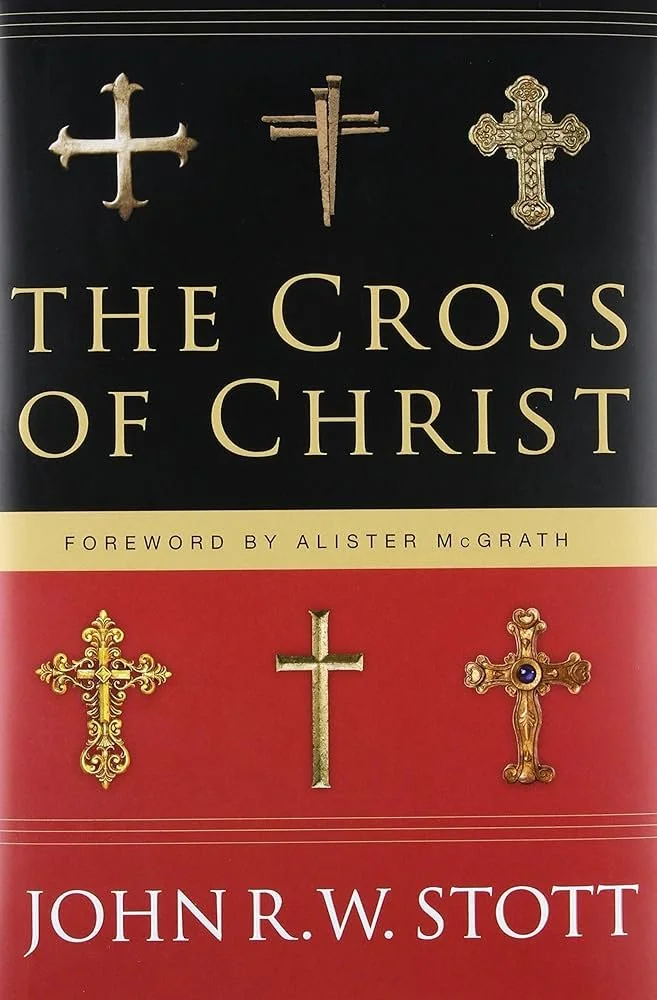
The Cross of Christ
By: John R.W. Stott
“I try to show that the cross transforms everything. It gives us a new, worshiping relationship to God, a new and balanced understanding of ourselves, a new incentive to give ourselves in mission, a new love for our enemies, and a new courage to face the perplexities of suffering.”
This is a theologically rich book that will deepen your understanding of the cross and why it is necessary, beautiful, victorious, and a revelation of God himself.
John Stott first wrote this book in 1985. I read the 20th Anniversary Edition that was republished in 2005 with a new foreword by Alistair McGrath. The Cross of Christ has long been considered a staple read for Christians (kind of like Knowing God or Mere Christianity) and I concur with that. I’m not sure there is another book out there that is more detailed and comprehensive regarding the cross and atonement.
I’ve had this book on my shelf for a few years now, always intending to read it, but knowing it would take me awhile, continuing to push it off. I’m glad I finally picked it up. Especially because recently I’ve been encountering more and more people rejecting penal substitutionary atonement (most recently in The Myth of Good Christian Parenting) which has baffled me.
I, like Stott, am surprised by how unpopular substitutionary atonement is. I then learned about all these different ‘theories’ of atonement, which I somehow hadn’t heard of before, but felt a little overwhelmed. I had no idea when I started Stott’s book that he would lay them all out for me, showing me what is appealing about each, where it is based in a truth, but most importantly, where they are incomplete.
That alone is worth reading this book because I think the average church-attender might not know how to discern distortions of the atonement. But there is so much more to this book than that. I took like 60 pages of typed notes while reading this book, folks. Even for someone lacking in brevity, that’s a lot of pages for me.
Stott’s writing, though a little dense at times, is very clear. It’s almost like a whole bunch of sermons in one book. He will have three reasons for such and such or four things we learn from this or four pictures that illustrate this, etc, and many summary statements that make it easy to follow along. If you wanted to outline the entire book (for some reason) it would be very straightforward to do.
One thing that is great about the book (at least in the anniversary edition— not sure if it’s in the original) is the Study Guide at the end. I didn’t notice it until I was a good chunk of the way through or I would have utilized it more, but it would be very useful for people wanting to read and discuss the book together or, individually, as a way to sum up and remember the main points of each chapter as you go along.
If you’ve ever wondered… why is the cross what most symbolizes and represents Christianity? why did Jesus die? why couldn’t God just forgive us? is the Old Testament God full of wrath but the New Testament God full of love? how do we reconcile God’s anger with his love? can God suffer? can God die? what’s the difference between justification and forgiveness? how is the cross glorious? why is the Lord’s Supper important? why would God allow us to suffer?… then this book is definitely for you.
It answers far more than these questions and even presents questions that I didn’t know I wanted the answers to.
Stott divides his book into four sections: Approaching the Cross, The Heart of the Cross, the Achievement of the Cross, and Living Under the Cross.
I’ll just share a few of the things in the book that really stuck out to me and my ultimate recommendation is at the end.
In the section about approaching the cross where he talks about why Jesus died and looked at the role of Judas, the high priests, and Pilate, he reminds us that we can’t fully separate ourselves from what happened on the cross. It’s worth quoting at length:
“If we were in their place, we would have done what they did. Indeed, we have done it. For whenever we turn away from Christ, we “are crucifying the Son of God all over again and subjecting him to public disgrace” (Heb 6:6). We too sacrifice Jesus to our greed like Judas, to our envy like the priests, to our ambition like Pilate. ‘Were you there when they crucified my Lord?’ The old negro spiritual asks. And we must answer, ‘yes, we were there.’ Not as spectators only, but as participants, guilty participants, plotting, scheming, betraying, bargaining and handing him over to be crucified. We may try to wash our hands of responsibility like Pilate. But our attempt will be as futile as his. For there is blood on our hands. Before we can begin to see the cross as something done for us (leading us to faith and worship) we have to see it as something done by us (leading us to repentance). Indeed, ‘only the man who is prepared to own his share in the guilt of the cross,’ wrote Canon Peter Green, ‘may claim his share in its grace.’”
In the section on the heart of the cross he gets right down to one of the hardest parts to understand about the cross and forgiveness. Why did Jesus have to die? Why couldn’t God just forgive us?
Much is said about God’s love today, and rightly so because he is love. But what is missing about this description is what Stott calls his ‘holy love.’
“His love is “holy love”, love which yearns over sinners while at the same time refusing to condone their sin. How, then, could God express his holy love— his love in forgiving sinners without compromising his holiness, and his holiness in judging sinners without frustrating his love?”
The answer is the cross.
“On the cross divine mercy and justice were equally expressed and eternally reconciled. God’s holy love was ‘satisfied.’”
The only response to sin by a holy God is justice. But because of his holy love, instead of making the guilty parties pay the cost, he substituted himself in our place.
As Stott goes through the other views of atonement, he shows that:
“All inadequate doctrines of the atonement are due to inadequate doctrines of God and humanity… The essential background to the cross, therefore, is a balanced understanding of the gravity of sin and the majesty of God. If we diminish either, we thereby diminish the cross. If we reinterpret sin as a lapse instead of a rebellion, and God as indulgent instead of indignant, then naturally the cross appears superfluous.”
For example, the view of atonement often called Ransom to Satan or Christus Victor originates from the idea that the cross was necessary because God had to satisfy Satan, that somehow he owed something to the devil because of our sin. But the cross was not a transaction with the devil as if he lorded any debt over God. It’s God we have sinned against.
Ambrose’s view of atonement is that Christ had to satisfy the law and that God had his hands tied, forced to require punishment for disobeying the law. But God is not imprisoned by his own law, he is the creator of the law and the law “is the expression of his own moral being” which is always self-consistent.
Anselm’s view is called the Satisfaction Theory and rightly accounts for the gravity of sin, the holiness of God, and the perfection of Christ and his voluntary death for us, but it seems to put Jesus and God on opposing sides, almost painting God as a “feudal overlord” demanding honor that Jesus, apart from God, decides to satisfy.
Abelard’s Moral Influence view emphasizes the cross as a demonstration meant to inspire repentance rather than an actual payment of sin.
“In differing degrees, all these formulations are true. The limitation they share is that unless they are very carefully stated, they represent God as being subordinate to something outside and above himself which controls his actions, to which he is accountable, and from which he cannot free himself. Satisfaction is an appropriate word, providing we realize that it is he himself in his inner being who needs to be satisfied, and not something external to himself. Talk of law, honor, justice and the moral order is true only in so far as these are seen as expressions of God’s own character. Atonement is a ‘necessity’ because it ‘arises from within God himself.’”
God must satisfy himself. And Jesus, as a member of the Trinity, is never at odds with the Father or the Spirit. They are one.
“We must never make Christ the object of God’s punishment or God the object of Christ’s persuasion, for both God and Christ were subjects not objects, taking the initiative together to save sinners… their wills coincided in the perfect self-sacrifice of love.”
Stott says that he hasn’t seen a more careful statement about substitutionary atonement as this one by Dr. Charles Cranfield:
“God, because in his mercy he willed to forgive sinful men, and, being truly merciful, willed to forgive them righteously, that is, without in any way condoning their sin, purposed to direct against his own very self in the person of his Son the full weight of that righteous wrath which they deserved.”
Stott then spends time talking about the Old Testament sacrificial system and the Passover to underscore what substitution means, who was eligible to make it, and why it was just.
Stott takes on all the objections and arguments and does a great job leading us through Scripture to show how essential the principle of ‘satisfaction through substitution’ is for Bible-believing Christians. He has strong words against anyone attempting to remove these from their theology. We can be sure that there is nothing immoral about penal substitutionary atonement (Christ taking on the legal punishment for our sin) because the substitute for us was “the Lawmaker himself.”
Again, I’ll quote at length here because it is a good summary that I’ll probably refer back to:
“The cross was not a commercial bargain with the devil, let alone one that tricked and trapped him; nor an exact equivalent, a quid pro quo to satisfy a code of honor or technical point of law; nor a compulsory submission by God to some moral authority above him from which he could not otherwise escape; nor a punishment of a meek Christ by a harsh and punitive Father; nor a procurement of salvation by a loving Christ from a mean and reluctant Father; nor an action of the Father which bypassed Christ as Mediator. Instead, the righteous, loving Father humbled himself to become in and through his only Son flesh, sin and a curse for us, in order to redeem us without compromising his own character. The theological words satisfaction and substitution need to be carefully defined and safeguarded, but they cannot in any circumstances be given up. The biblical gospel of atonement is of God satisfying himself by substituting himself for us.”
In the section on the achievement of the cross, he covers three things the cross did: rescued us (salvation), disclosed himself (revelation), and overcame evil (conquest).
He goes through four ‘theology’ words with helpful and easy to understand illustrations that help us see a complete picture of salvation:
“Propitiation introduces us to rituals at a shrine, redemption to transactions in a marketplace, justification to proceedings in a court of law, and reconciliation to experiences in a home or family. My contention is that ‘substitution’ is not a further ‘theory’ or ‘image’ to be set alongside the others, but rather the foundation of them all, without which each lacks cogency.”
“Each of these four New Testament images of salvation highlights a different aspect of our human need. Propitiation underscores the wrath of God upon us, redemption our captivity to sin, justification our guilt, and reconciliation our enmity against God and alienation from him.”
He declares that ‘substitution’ is not a ‘theory’ of atonement but the very essence of it.
In the section on living under the cross, I really enjoyed the chapter about self-understanding.
Many today confuse self-affirmation with self-love. He does a great job of showing how it is biblical to both deny yourself and affirm yourself:
“The self we are to deny, disown and crucify is our fallen self, everything within us that is incompatible with Jesus Christ. The self we are to affirm and value is our created self, everything within us that is compatible with Jesus Christ. True self-denial is not the road to self-destruction but the road to self-discovery.”
“the cross is the God-given measure of the value of our true self, since Christ loved us and died for us. On the other hand, it is the God-given model for the denial of our false self, since we are to nail it to the cross and so put it to death… we see simultaneously our worth and our unworthiness, since we perceive both the greatness of his love in dying, and the greatness of our sin in causing him to die.”
(These truths align so well with Galatians which I just happened to be studying while reading this book. It was a pleasant surprise that the Conclusion went through the entire book of Galatians!)
The cross not only corrects our view of self, but is also the foundation for how we love our enemies.
This chapter was the practical ‘how to live in your community’ with this knowledge part.
The last chapter looks at how the cross informs our view of suffering. I thought this part was really good too. I’ve read a lot of books on pain and suffering— which I can only imagine must mean God is equipping me for something down the road— so this wasn’t necessarily new information but it is always good to be reminded how suffering is attached to growth and maturity. Suffering, however painful, is not Godforsaken; God is there with us. We share his sufferings that we might share in his glory when all is made right.
When we change our mindset to expect suffering, knowing God is refining us, pruning us, we can endure for our loving God is producing a holiness in us that is made for heaven.
“The cross does not solve the problem of suffering, but it supplies the essential perspective from which to look at it. Since God has demonstrated his holy love and loving justice in a historical event (the cross), no other historical event (whether personal or global) can override or disprove it.”
Some other quotes:
“whether we like it or not, we are involved. Our sins put him there. So, far from offering us flattery, the cross undermines our self-righteousness. We can stand before it only with a bowed head and a broken spirit. And there we remain until the Lord Jesus speaks to our hearts his word of pardon and acceptance, and we, gripped by his love and full of thanksgiving, go out into the world to live our lives in his service.”
“that Christ died for us, for our good; that the ‘good’ he died to procure for us was our salvation; that in order to procure it he had to deal with our sins; and that in dying for them it was our death that he died.”
”It is altogether an error… to suppose that God acts at one time according to one of his attributes, and at another time according to another. He acts in conformity with all of them at all times… It is a case of combined action, and not of counteraction, on the part of these attributes, that is exhibited on the cross.”— Thomas J. Crawford
“What looks like (and indeed was) the defeat of goodness by evil is also, and more certainly, the defeat of evil by goodness. Overcome there, he was himself overcoming. Crushed by the ruthless power of Rome, he was himself crushing the serpent’s head. The victim was the victor, and the cross is still the throne from which he rules the world.”
“In fact, all three of the major explanations of the death of Christ contains biblical truth and can to some extent be harmonized, especially if we observe that the chief difference between them is that in each God’s work in Christ is directed toward a different person. In the ‘objective’ view God satisfies himself, in the ‘subjective’ he inspires us, and in the ‘classic’ he overcomes the devil. Thus Jesus Christ is successively the Savior, the Teacher and the Victor, because we ourselves are guilty, apathetic and in bondage. [1 Cor 1:30] ‘justification, sanctification, and redemption’… some may gravitate to the great Deliverance, some to the great Atonement, and some to the great Regeneration’ yet all are part of the Savior’s total accomplishment, ‘the destruction of evil, the satisfaction of God, and the sanctification of men.’” (Forsyth)
“To sum up, the gospel includes both the death and the resurrection of Jesus, since nothing would have been accomplished by his death if he had not been raised from it. Yet the gospel emphasizes the cross, since it was there that the victory was accomplished. The resurrection did not achieve our deliverance from sin and death, but has brought us an assurance of both.”
“To be an enemy of the cross is to set ourselves against its purposes. Self-righteousness (instead of looking to the cross for justification), self-indulgence (instead of taking up the cross to follow Christ), self-advertisement (instead of preaching Christ crucified) and self-glorification (instead of glorying in the cross)— these are the distortions that make us ‘enemies’ of Christ’s cross”
Recommendation
This will not be a light or fast read, but I do believe it to be an accessible and essential read to expand and deepen your understanding of the cross.
I think I’ll be coming back to my notes a lot as different questions come up. This book is a classic for a reason and I recommend it whether you are a pastor, a layperson, or even an atheist who wants to know what the heck the deal is with all the cross stuff.
Rest assured, the cross does not put God’s wrath at odds with his love, but presents the most beautiful combination of them— his holy love— that is our path to freedom and to life and leads us to worship and service in gratitude that he made a way for us that we did not deserve. Thank you, Lord.
You can order a copy of this book using my affiliate link below.
Share this book review to your social media!