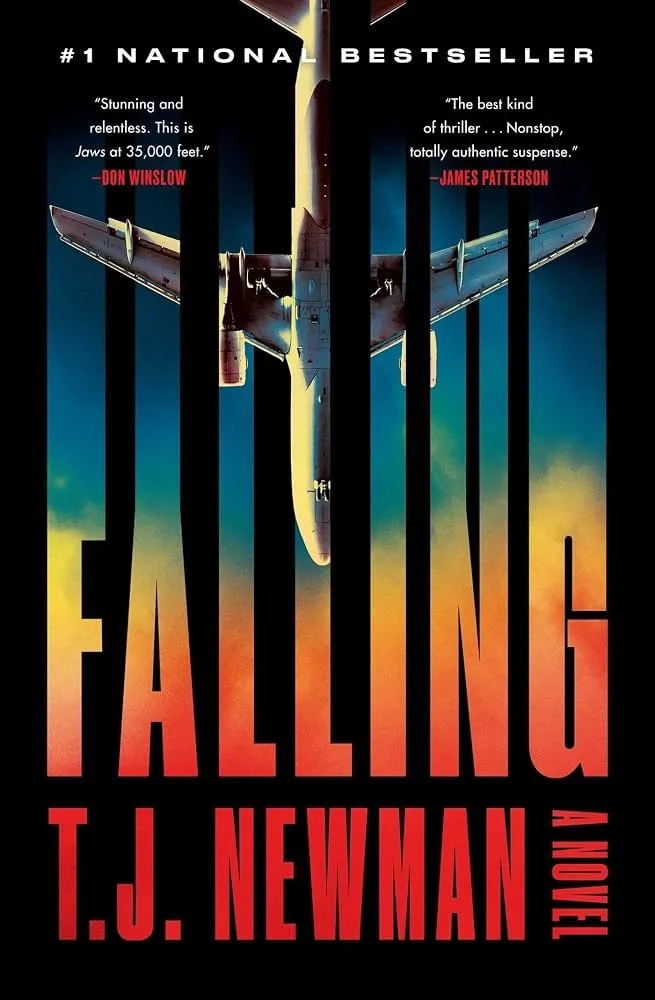
Falling
By: T.J. Newman
[Fulfills prompt: ‘A book you picked by browsing library shelves’ for the Shelf Reflection 2026 Reading Challenge]
“When the shoe dropped into her lap the foot was still in it.”
How’s that for a first sentence of a book?!
There was no build up to the action and tension in this thriller— it dropped in our laps quite literally— and it stayed at mach speed for the duration of the book.
It actually felt like I was watching a movie and when my kids interrupted my reading I almost felt like I needed to say— ‘I’m watching something, just wait til I’m done!’ The whole book takes place in the course of one day and with under 300 pages, you probably could read it in one dedicated sitting if you didn’t have any other responsibilities.
With the basic premise of a terrorist hijacking a plane, the 24 vibes were strong— except our Jack Bauer character was probably split between the pilot, Bill, and the FBI agent, Theo.
It’s a book about bravery and heroism. About putting humans in worst case scenarios and seeing both the worst humanity has to offer, but also the best. There will always be people who self-preserve to the detriment of others and those who rise up, inspired to self-sacrifice for the good of others.
(If you’re thinking that you don’t want to read about severed feet, don’t worry, the first chapter is a dream and it’s not like that the whole book. You could just skip that part and you won’t miss anything.)
The choice at the heart of this book is one we all hope we will never have to make— do I choose to save my family or a whole bunch of other people?
In Falling, Bill is a pilot whose family (wife and son, 10, daughter, 10 months) are kidnapped.
“You will crash your plane or I will kill your family.”
The target of the plane crash is undisclosed. He is also tasked with releasing a poisonous gas into the cabin with all the passengers. A backup plan is in place, we’ll know if you tell the police, yada yada, all the things in place to tie his hands. It’s an impossible choice with seemingly no good outcome.
I was actually kinda shocked with how quickly we get into it; I wondered how we were going to have enough material for the rest of the book if we already know the main conflict?
But it all worked. Nothing dragged.
There was nothing superfluous in this story.
Well, that’s probably not entirely true… there were some flashback moments for some of the characters that revealed what memories were behind their actions or choices. Some reviewers didn’t like those parts, but I didn’t mind getting more context in short snippets.
Because it all happens in one day it’s not like there’s a lot of room for character development and with all the action I would have been annoyed to have entire chapters of ‘flashbacks’ breaking up the flow. I think Newman did it right.
We have chapters that follow Bill in the cockpit, ones covering Carrie (his wife) and the kidnapper/terrorist, and then we have chapters for Jo (the main flight attendant and friend to Bill) and Jo’s nephew, Theo, who works for the FBI. So four main settings we jump around to with each chapter ending on a cliffhanger.
For a debut novel I was impressed with Newman’s ability to maintain suspense, introduce new problems, and find ways for the characters to solve them. Her previous career as a flight attendant obviously gave her a lot of personal experience to work with in terms of the operations of a flight. I took no issue with the writing style, dialogue, or flow.
Sure, the flawless internet connection Bill and the on-ground terrorist maintained feels pretttttty unbelievable, but at the same time I would also totally buy that there’s magical domestic flight internet that crew members are able to access that they keep from everyone else on board.
Some reviewers complained that it was just a standard hijacked plane story, that it wasn’t innovative and everything was stereotypical.
Are those the kind of people who prefer to watch the critically acclaimed, Academy Award winning movies? Because I’m all about that summer blockbuster action movie even though it’s probably just like all those other action movies! Unless there’s too many car chase scenes, I’m usually thoroughly entertained.
To me, Falling is a summer blockbuster. It’s not going to change your life. You might not even remember it next year, but you really enjoyed it while it was happening. And there’s nothing wrong with that!
Stereotypes and cliches? I mean… what’s the stereotype of a flight attendant; how would you even subvert that? Also, if ‘courageous hero’ is a stereotype I will take it every day of the week. I don’t want to read about cowards. I’ll take the unrealistically brave. We want to be inspired! We like heroes!
The only stereotype I could see people taking a legitimate issue with is that the terrorist is from the Middle East. But… at the same time. I don’t really see a lot of terrorist acts being committed in America by other groups. Newman used a historical reality between the Kurds and the US to act as the catalyst so it doesn’t seem like an unfair choice. And really it was individuals planning an attack, not a group or organization or even a religion so it didn’t feel like Newman was painting with broad strokes at all when she chose ‘the bad guys.’
A Deeper Conversation
If we are going to move beyond just appreciating the book as a blockbuster (which it quite literally is in the works with Universal to be that) then we can have a conversation around this: What tragedies around the globe are people reasonably responsible for trying to help with or fix?
The terrorists lay some pretty heavy accusations against Bill (and Americans at large) for not caring at all about the Kurdish villages being gassed by the Turks when Reagan withdrew American troops from their territories (which really happened). They throw his ‘privilege’ at him because he was just going about his life while people were dying and he didn’t even care.
Bill expresses empathy and makes a commitment to do better and do the work to try to help and learn more about it, etc, etc.
I’m not bringing this up because I necessarily have answers. But I think it’s a really interesting conversation to consider.
Before the age of internet and especially social media, people were largely oblivious to crises happening on the other side of the world, or even the country. Now that we can know in real time what’s going on, how much can we mentally, emotionally, or physically take upon ourselves? And if we don’t, does that make us apathetic, selfish, and uncaring?
I definitely think people should care in general, but I can’t fathom having the mental and emotional capacity to think about all the tragedies and deaths occurring across the globe. It would be impossible to learn about all of it. It would consume you. And what could you realistically offer?
When the camp in Texas was flooded last year and so many little girls were killed, I could have just sat there and cried for days. It made me so sad. But I still had four children to take care of. I couldn’t let it distract me from my responsibilities as a parent. I had to stop watching the videos or it would consume my thoughts and my ability to show up for my family.
I’ve thought often about God’s command to love our neighbors. We have to ask— who are our neighbors? Not that we ignore people who need help on the other side of the world, but I do think our local context matters. We have the ability to really serve and love the people we encounter in our daily lives and that’s not nothing. It’s something we CAN do. Spending too much time learning about global crises and conversing online to ‘increase awareness’ at the expense of actually doing something tangible seems like the selfish, privileged thing to do.
So yeah, I do think it’s an important conversation. I don’t think there are clear lines or answers, and I’m definitely not over here doing it right, but I have found these types of questions good for pondering and pondering with others.
Recommendation
If you love a good summer blockbuster movie and enjoy being entertained with lots of action and bravery and heroism, this is your book. It’s a standard, fast-paced, good thriller. I don’t know what else to tell ya.
If you do not like action, planes, or courage, or you prefer (or at least prefer right now) books with really long sentences, big words, and a complicated plot, you might want to pass on this one.
Not that I need more airplane fiasco scenarios to fill my imagination before my next flight, but I do plan to read her next book called Drowning because many reviewers claim it to be even better than this one.
[Content Advisory: 14 f-words, 21 s-words; no sexual content; some violence and a severed foot but there’s more tension than violence]
You can order a copy of this book using my affiliate link below.
Share this book review to your social media!