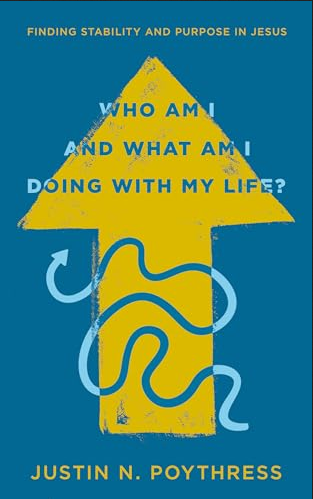
Who Am I and What Am I Doing with My Life?: Finding Stability and Purpose in Jesus
By: Justin N. Poythress
“Sometimes the open-endedness of life can feel like opportunity, but other times it feels like self-doubt and missing out.”
This is not the first book I’ve read on identity, but definitely one that should stay in the conversation.
I’m entering a new phase of life with my kids all going to school and I’ve been pondering what I do with my time now. I haven’t stopped being a mom, but my daily duties will be different during the school year. I wondered if this book might speak into that for me and help direct what I do with my life.
I was a little wrong about the direction this book was going to go, but I enjoyed it nonetheless. It takes a more broad approach to the ‘doing’ part and hones in more on the ‘Who am I?’ part. Which actually does help because what we do flows from who we are.
I think Poythress does a great job of understanding our cultural moment and the ways we tend to fashion our identities. He explains them and then looks at how Scripture has a better way.
So the two strengths of his book are 1) identifying how the world’s ways of forming identity are unsatisfying and 2) explaining what ‘finding our identity in Christ’ actually means.
It’s possible you’ve never really given much thought to what your identity is, or maybe you feel like everyone is always talking about identity and you’ve just been tuning it out at this point. Wherever you fall on that spectrum, I think this book would be a valuable read for you, especially if you’ve ever commented on wanting to be ‘the best version of yourself’, you’ve attempted to ‘manifest’ the kind of person you want to be, you’ve struggled with authenticity, you’ve wondered how you could ever truly feel free, or you’ve wondered what story your life is telling. At the very least, it may reveal to you some idols you have in your life or things or identities that are shaping the person you’re becoming without you even realizing it.
Overall, I think Poythress’s book will bring you clarity, confidence, and peace.
Poythress offers this helpful definition of identity and the internal struggle we face as we seek to know ourselves:
“Identity discussions are a push-pull between understanding who you are as a product of the past and who you wish to be in the future…. You are both being and becoming… You long to feel that parts of you are stable and good and valuable—these are the things that make you who you are. And yet you want to be growing and maturing, open to change and development.”
Though I’ve read many books that discuss identity, I’m not sure I’ve heard it put quite like that and it makes total sense. There is a relationship between what he calls the ‘givens’ (being) of who we are, but also the reality that we are always changing and transforming (becoming).
He has a helpful diagram of a hierarchy of identities made up of identities of origin (nationality, ethnicity, gender, age, past life choices), identities of role (vocation, relationships, hobbies, responsibilities), and identities of affinity (values, passions). These layers all culminate at the top with our ‘Master Identity’ — one identity to rule them all! It’s the interpretative lens you see all your other identities through: “A master identity is like the CEO running the company of your self. It promotes one sub-identity and fires another.”
This was good to visualize how we should rightly understand all the pieces that contribute to who we are.
I like how he references Romans 8:29 as God’s identity plan for us: “To be conformed to the image of his Son.”
The becoming, the transformation, is our purpose. The big Bible word for that is sanctification.
The easy answer for how we become who we were meant to be is by “beholding the glory of the Lord.” (2 Corinthians 3:18)
“Your master identity is formed by what you love. And what you love is what you behold. And what you behold will shape you. It will shape who you spend time with, what you do, what you say, and how you say it. It will inform all your other identities.”
It’s hard because we keep failing to do it, but it’s easy because just the one thing— being focused on God, loving him, worshiping him— has such a major impact on the people we become. We can’t help but become like him if we are focused on him.
So: the confusion we feel when we’re told ‘No one else can tell you who you are but you. Look deep enough inside yourself and discover your true self’ and then we try so hard and we can’t figure it out or it doesn’t last; the addictions or the habits that we can’t seem to shake and seem to be consuming us; the internal war we experience as we wonder if we’re being authentic; the fear we feel as we wonder if we’re being manipulated or controlled by nefarious third parties… all of these things fade away if we are beholding Christ.
If we are beholding Christ, we don’t have to have the burden of determining our true selves:
“Out of all the givens that make up your struggles, your background, your giftings and deficiencies, and your environment, there are some that you do not like and would not have chosen. But if there’s anyone you can trust to tell you what to do with those givens, and how to become your best self, it’s the God who created all those givens in the first place.”
We can explain our internal war with ourselves and find confidence that fighting isn’t failing:
“In its honest teaching about our sinful nature, then, the Bible gives you hope. It gives you a way to see, love, and be proud of an authentic version of your self, while hating and fighting against the other authentic, but sinful version of your self.”
We find peace that we can trust the One who is in control, that his boundaries and restrictions offer us freedom to be who we are supposed to be:
“Realize that you will always have a master of some kind, so to become your best self, you need to find the best master. That’s God. (Mt 11:28-30)… even when you’re getting it wrong, there is someone looking out for you who is getting it right. He can take even your worst failings and fold them into his plan to make you into your best self.”
Another thing I loved that Poythress points out in his book is the necessity of community. We don’t need to try to isolate or block out everyone so we can be alone to find ourselves, we actually NEED others to help be who we are supposed to be. We were made to live in community.
“Our culture has set up a trap. You either feel inauthentic— that you’re being shaped by someone else— or you end up lonely and still uncertain because you won’t trust anyone else to test your conclusions… Your true self is always connected to other people. In the absence of real, known-and-knowing community, people wander into thin, transient digital communities that are cultivated by brands and celebrities.”
(More on that if you read Scrolling Ourselves to Death)
The way we relate to other people shapes us, but we also need people to help us see our own blindspots.
One of the last chapters of his book Poythress goes through three red herrings— things that seem really important but, though powerful, are false clues to who we are: work, sexuality, and politics.
He did a great job of showing how God’s good gifts can be twisted into idols that take his place as our Master Identity.
My husband is a financial advisor so Poythress’s last analogy resonated with me in terms of how we see our master identity and God’s role in being in charge of who we are:
“Think of your multiple identities like an investment portfolio. When you make Jesus your master identity, it’s like signing up for an expertly managed index fund. Jesus will perfectly balance all the other parts of your identity to serve the one goal of becoming more of who he’s made you to be— your Jesus-self. The trouble with these three red herrings of identity is that they produce an unbalanced life. They overconcentrate your identity in one stock, so to speak. You’re subsequently exposed to high levels of risk, violent fluctuations, and ultimately bankruptcy.”
Beholding Christ puts God in charge to balance all the pieces of what makes us who we are. He can manage our being and becoming if we trust him. If we try to do it ourselves, we will make bad investments that will leave us with volatility and anxiety.
“If you immerse your mind in beholding Jesus, you will have a stable context, a stable vision, and therefore a stable identity— even as you continue to grow.”
Recommendation
I definitely recommend this book for those who feel unstable and unsure of who they are or how they’re supposed to decide/discover who they are. I recommend it for people who believe that their work, their sexuality, or their politics are the core of their being and the blueprint for their becoming.
I also recommend it for people who know that their identity should be in Christ but don’t really know what that means. For those feeling unsure if they’re being authentic or ‘doing it right.’
I can see this being a vital resource for teenagers and young adults, especially, who are under the most pressure to fashion identity and also most influenced by the culture’s methods for doing so.
It’s a really easy to read, casual but profound book that will give you clarity, confidence, and peace as you think about who you are and who you want to become.
**Received a copy via The Good Book Company in exchange for an honest review**
You can order a copy of this book using my affiliate link below.
Share this book review to your social media!