Lost Lambs
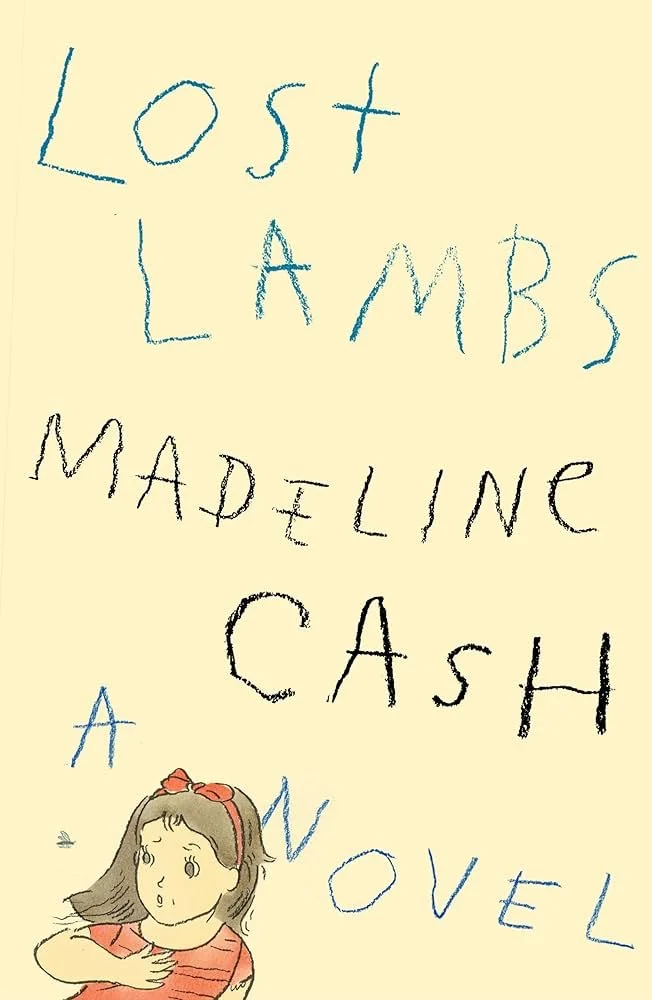
Lost Lambs
By: Madeline Cash
[On my list of Most Anticipated Books of 2026]
This is a book all about what gnat to do in your life.
It is unapologetic, uncomfortable chaos.
One reviewer said it’s like if Wes Anderson wrote Little Women. I’m not sure about the Little Women part because I only read 100 pages and didn’t finish Lost Lambs and have no idea where it was going, but I definitely agree with the Wes Anderson part.
Lost Lambs is bizarre and quirky and dysfunctional and crude in a matter-of-fact way that I think is supposed to be funny in its absurdity.
I have not watched many Anderson movies but I did watch Asteroid City and when it was over I just looked at the credits rolling and said— ‘What…? Why….?’
I couldn’t necessarily articulate why, I just knew I didn’t like it.
That’s what I felt with Lost Lambs.
This was a debut book on my Most Anticipated List and I was a bit uncertain about it because I don’t usually enjoy dysfunction or irreverence. But in certain capacities it can work and because Goodreads marketed it as “rippling with humor, warmth, and style” and that it was charming and quick-witted and “surprisingly tender,” I thought it might be something outside my normal reading sphere that could be good or at least interesting or entertaining.
It did not take long for me to stop reading and go find some other reviews because it was just so…. weird… and— like I think everyone reading this book— I didn’t know what I had gotten myself into.
Once I got my bearings and saw that there was some underlying ‘mystery’ that was most likely going to join the family together in solving, I decided to press on. I could handle a little weird.
Unlike many reviewers, I actually loved the extra ‘g’s and mostly because it seemed like they were there purely there for the author’s own amusement as they were not character-specific. Why was this my favorite part?!
I liked the writing style. I liked the clever wit. Here’s a couple examples of the style of humor (although the humor makes more sense in the overall context of the story):
“‘I can’t feel my hands in a bad way… What if I never feel them again? What if we never have another thumb war?’
‘It’s alright. We’ve never had a thumb war.’
Abigail wondered if Wes disliked their gratification of war.”
Or:
“‘We don’t have money for that. I have to put you and your sisters through college.’
‘Who’s going to college? Abigail will marry rich, Harper will go to prison, and after high school I have to surrender my life unto God.’”
But the absurd and crude family escapades are not just introductory to the family dysfunction, they are a continual part of the book.
One teenage daughter has a relationship with an older man, the middle daughter is in love with a man online that she’s apparently unaware is an Islamic terrorist who is trying to radicalize her, and the youngest daughter is the weird genius set on uncovering a nefarious plot with her dad’s company. Then we have the wife who wants an open marriage and laments her non-grand/artistic life of being a mom so she gets reeeal friendly with the neighbor. And the husband who does not want an open marriage but is too proud for any sort of self-reflection that could rectify the situation and lives at the whim of his most base desires (and also he lives in their minivan).
In Cash’s own words: “I wanted everyone to have a subversion of their stereotype. The church lady who’s supposed to be a nuisance ends up not only complex but also sexual, almost erotically spiritual, and the local pastor is into French cinema. I wanted every figure to undercut how they’re initially read.”
Subversion means a corruption or overthrowing of something… I think she accomplished the corruption part fairly well.
I was intrigued by where the story was going when we learn that ‘Lost Lambs’ is the name of a support group the husband attends through their Catholic church— is this where redemption and correction begin? Nah… pretty much immediately he ends up at the support-group-host-lady’s house at night and things get out of hand, and I decided to throw in the towel. At that point there was no character safe from moral depravity.
It was interesting to read the ‘praise for Lost Lambs’ on the back of the book… One said they were “laughing throughout— even when I was horrified”… Another said: “With a big surge of energy, Lost Lambs splits the nucleus of the American family. Madeline Cash likes to get dark, but fortunately the dark is where her writing glows.”
I’m just not sure I like the idea of a book that makes light of familial destruction and tries to make darkness shine.
This is a work of satire. Which means it’s meant to be a humorous exaggeration to expose vices or systemic problems.
But even knowing that, I just had no idea what message was trying to be sent. And I didn’t want to wade through all the crudeness and sexual content to figure it out.
Turns out, I think I just don’t really like satire very much. Especially if it’s somehow intertwined with religion or Christianity. I care too much about ‘the truth’ to allow it to be confused with a huge ball of vague exaggeration, hypocrisy, and all manners of sin. In a story like this, how is one supposed to tell which parts are the truth and which parts are the lies? Which parts are they mocking? How do I love Christ’s church if I’m trivializing its existence?
My world is pretty black and white and I have a hard time enjoying myself in the gray areas. I feel morally conflicted when good and evil are blurred together and I’m supposed to laugh about it.
If someone wants to critique the church, great, we should all be held accountable for reflecting the real gospel and I’m open to hearing where the church is falling short. But I would rather read a nonfiction book that deals with facts and evidence and real stories than try to peer through the humorous ‘don’t take us too seriously but also do’ veneer of satirical novels.
Based on a lot of reviews I read, there may not even be much of a redemption arc in Lost Lambs. I think they all just stay lost. Because lost is… raw?… and raw is… best? I don’t know. The secular viewpoint seems to be: let’s explore different ways of loving and how we all still ‘show up’ for each other and how endearing this is even though our choices are unapologetically chaos; lifestyles apparently have no moral consequence as long as people come when it’s super important.
Today’s trend seems to be finding ways of viewing dysfunction as endearing and maybe actually a good thing after all. As long as it’s genuine and confident and in the open, we can do whatever we want- it’s okay!
I wasn’t going to add all this… but then I stumbled across this interview Hannah Tishkoff did with the author, Madeline Cash (who must be a childhood friend of hers).
It offers a little bit of insight as to where the ideas for this book were coming from.
I thought it was interesting that right off the bat Tishkoff wants to make a connection between ‘Lost Lambs’ and Psalm 23. She hears ‘The Lord is my shepherd; I shall not want’ and implies— “If God is our shepherd, then wanting is the condition of having wandered. To want too much is not simply to desire, but also to flee responsibility, to take the reins prematurely, to mistake autonomy for adulthood. In this sense, to be lost is not to be free but to remain infantile. A lamb, not yet a sheep.”
Her explanation of ‘wanting’ makes me think more along the lines of the Prodigal Son parable. Someone who had everything he needed but fled for ‘autonomy’ and indulging infantile desires. He ultimately returned home, realizing he really messed up and his way was not the good way.
When I saw the title ‘Lost Lambs,’ I also thought of Psalm 23.
But when I look at the whole psalm I read about a Shepherd who gives us everything we need. We lack (want for) nothing. He gives us peace and restoration for our souls. He guides us in paths of righteousness for his own glory. He comforts us in hardship and gives us confidence to face evil. He invites us to his victory feast as reigning and sovereign King. He sends his grace and mercy after us.
In this sense, to be a lost lamb is to be rejecting God’s provision and guidance, inviting chaos, chasing immorality, living in fear— fear of failure, of death, of unfulfillment, of aimlessness, of uncertainties, wandering without boundaries.
Tishkoff and Cash point out that not ‘believing in anything’ leaves people isolated and alone. They say people need to rely on something outside themselves:
“You need other people. I think that probably is my higher power. It’s not a specific person but just community as a whole, whether it’s your support group or a book club. Just the idea that you cannot do anything alone is so fundamental that it’s biblical.” (Cash)
I agree that community is important and we were created for relationship, but they’re still missing the point. It’s not first about having a flock. It’s about having a Shepherd. In Psalm 23, the sheep aren’t doing anything themselves. They are just following the Shepherd who is leading them to nourishment and protecting them from wolves.
If it was just a flock of sheep boppin’ around the meadow, they might find some food, or they might just get eaten by wild animals. Or they may even follow each other right off a cliff— which is literally called extreme ‘flocking’ and is exactly something shepherdless sheep do. They might have each other, but they’re still lost and in danger.
When Jesus saw the crowds “he had compassion for them, because they were harassed and helpless, like sheep without a shepherd.” (Matt 9:36)
‘You cannot do anything alone’ is truly a biblical concept:
Jesus says in John 15 that he is the vine and we are the branches— we can only bear fruit if we are rooted in him.
Paul encourages the people of Colossae (2:6-8) to walk in Christ, being rooted in him, established in his teachings so they’re not taken ‘captive’ by the theology of the world.
2 Corinthians 3:5 talks about our sufficiency coming from God.
Paul informs the people of Athens in Acts 17 that our very life and breath come from God.
Notice the commonality. While we serve together as the body of Christ, helping one another as we can, the main root is God. Our Creator, Sustainer, and Shepherd.
Cash seems to understand this foundational biblical concept but instead of submitting to it, she seems to reject it, manufacturing a lesser version on her own terms.
It’s no surprise that Lost Lambs is a showcase of rebellion.
Cash says of her characters, “They need to rebel to become well-rounded.” She comments how the parents are rebelling against the institutions of marriage and religion.
She almost treats rebellion as a noble rite of passage to maturity. Buck tradition. Buck the system. I believe persevering in hardship matures us, but rebelling against marriage and truth authored by the Creator from the very beginning does not have the same effect.
So if the author is talking about lost lambs and rebellion and biblical concepts of relying on someone outside ourselves, then we have to acknowledge the foundational truth that a ‘lost lamb’ at its core is someone who rebels against their Creator and his design and the moral character he has written on their hearts as a reflection of his own holiness. It is the arrogance that says ‘I know better’, turns away from the guide and wanders their own way. To rebel is the ultimate sin.
God speaks in Isaiah 30 and calls his people “stubborn children…" saying they “carry out a plan, but not mine, and who make an alliance, but not of my Spirit, that they may add sin to sin.” There are several following verses detailing Israel’s rebellion, that they are “unwilling to hear the instruction of the Lord” and “trust in oppression and perverseness and rely on them.”
Cash shows us lost lambs, these stubborn children, but she seems content to let her characters stay lost, shepherdless.
Praise God that he doesn’t want us to be lost lambs! He comes out looking for us. After all the lamenting of Israel’s rebellion, verse 18 says “Therefore the Lord waits to be gracious to you, and therefore he exalts himself to show mercy to you. For the Lord is a God of justice; blessed are all those who wait for him… your ears shall hear a word behind you, saying, ‘This is the way, walk in it.’”
Satire is not just meant to make you laugh, it’s made to make you think.
So think about the problem Madeline Cash has laid bare in Lost Lambs. And decide if her solution to the problem is satisfying. Does it answer your own questions about what it means to be lost or found?
If you resonate as a lost lamb, I invite you to look for the Good Shepherd who is waiting to show you grace and mercy, to give you all that you need, to give you rest and guidance, to care for you like no one else could. Do you have ears to hear the word behind you?
The “freedom” of rebellion is not all it’s cracked up to be.
Recommendation
Well, no, I don’t really recommend this book. It’s got some absurd humor, wit, and some amusing ‘g’s’, but it’s just chaos without redemption.
I can’t really imagine encouraging someone to enter into this mess.
Of course I know there are a lot of people who read my reviews that don’t share my worldview and based on reviews there is clearly an audience for this book. My lack of recommendation is not for writing style, but for content (…and lack of content). So perhaps this is a ‘read at your own risk’ kind of thing.
I would egncourage you, though, that if you are going to enter the vortex that is Lost Lambs, consider the Good Shepherd who is looking for you because this book doesn’t have what you need most.
[Content Advisory: in the 100 pages that I read there were 6 f-words, 1 s-word and a variety of sexual commentary and encounters, solo and otherwise]
Share this book review to your social media!