Scrolling Ourselves to Death
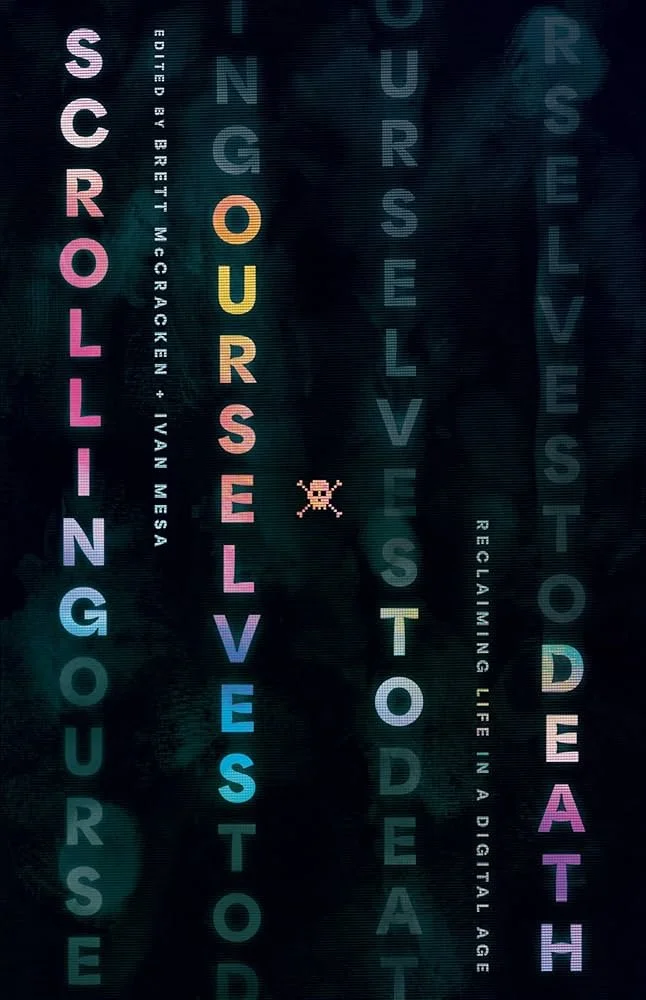
Scrolling Ourselves to Death: Reclaiming Life in a Digital Age
Edited by Brett McCracken & Ivan Mesa
“The church must step in and speak truth that gives life, redirecting glazed-over eyes and lifting hunched-down faces to behold the one who is infinitely more satisfying than whatever fleeting amusements flash across our screens.”
Wow! What a necessarily pessimistic yet optimistically hopeful book we have here.
Over the years my relationship to technology has oscillated from joy— because I can get my groceries delivered to my house and can google all my weird questions and get immediate answers to satisfy my curiosity— to fear and anxiety as I am bombarded with every global tragedy and angering political stance and spend time wondering how AI will somehow be used to frame me for some bizarre crime I didn’t commit (I read a lot).
It’s a wild world we live in.
How do we make sense of it all? How should a biblical worldview shape our evaluation of technology and our personal use of it? This book, written by 15 different contributors engages with the prescient writings of Neil Postman, writer of Amusing Ourselves to Death, the title of which Scrolling Ourselves to Death is derived from.
Amusing Ourselves to Death was written at the dawn of television. Postman lamented how easily our culture became content with entertainment instead of substance, visual distraction instead of intellectual engagement.
I was drawn in immediately in reading Scrolling Ourselves to Death when McCracken (fantastic last name) shared Postman’s evaluation of the dystopian futures depicted in both 1984 and Brave New World. Postman, who was writing Amusing in the year 1984, was curious to see which dystopian prediction had most come to fruition. He observed:
“Orwell feared those who would deprive us of information. Huxley feared those who would give us so much that we would be reduced to passivity and egoism. Orwell feared that the truth would be concealed from us. Huxley feared the truth would be drowned in a sea of irrelevance. Orwell feared we would become a captive culture. Huxley feared we would become a trivial culture, preoccupied with some equivalent of the feelies … In 1984 people are controlled by inflicting pain. In Brave New World, they are controlled by inflicting pleasure.”
When I recently read 1984, I could see a lot of parallels to today, but now I also see the sneaky control of Brave New World and how susceptible our current culture would be to such methods.
What Postman recognized decades ago when television came on the scene is even more evident in our era of pocket supercomputers: we are a culture distracted and shaped by technology and our pursuit of pleasure and entertainment.
In every chapter of Scrolling Ourselves to Death an author compares Postman’s findings to what we see in our world today and goes a step further by looking at it through a biblical lens— what does this mean for Christians and what do we do about it?
There have been many books written about this topic— including Haidt’s recent and popular book The Anxious Generation— so you may not be surprised by all the studies finding how addicting dopamine-inducing scrolling is or how isolated and lonely people are even though they’re ‘more connected’ to the world than ever before. You might not even be surprised that the suicide rate for kids increased “62% between 2007 (the year the iPhone debuted) and 2021.”
But you may be surprised to know that the authors of this book are not asking you to abandon technology.
What I loved about this book was not just the thoughtful and careful analysis of Postman’s work and its increasing relevance for today (and where his conclusions fall short), it was how every chapter contained constructive ideas or hopeful encouragement.
Books that critique technology and show us all the terrible consequences of it can just make us more anxious or fearful or overwhelmed by how integrated it is in our lives. How could we ever change something so pervasive? I don’t like the books that tear everything down and then basically hold up two fingers and say ‘Peace.’
In contrast, Scrolling Ourselves to Death actually offers real peace reminding us that:
“Ultimately, the call isn’t to abandon technology, but to bring it under Christ’s lordship.… In him, we have enduring hope, unshakable truth, and eternal life – the things we crave that our secular age and its technologies can’t supply. By keeping our eyes fixed on Jesus, we can boldly and creatively use technology for his glory and for the good of his church.”
While I can’t impart all the good things to you that I read within these pages, I’ll highlight some of the points they make that are especially important for Christians to think about:
Technology is shaping how people determine what is true and good.
Postman recognized the shift in ‘currency’ when television came on the scene. Content depth was traded for entertainment value.
“religious ideas are increasingly judged by their ability to entertain and hold the audience’s attention, rather than by their spiritual truth or theological depth…”
This was the movement into a ‘consumer’ Christianity.
Several of this book’s authors build on that understanding, sharing how people’s beliefs about what is true are so often shaped by TikTok or YouTube videos and the like before they even step into a church.
Rich theology can’t be fully imparted in thirty second videos by people presenting the information in the most click-bait or evocative way.
“Does the internet deliver popular access with complex arguments? Or does this medium— think of social media in particular— privilege certain messages that divide us?”
Postman coined the ‘Now… This’ effect which is a “rapid, superficial succession of information, designed to be discarded.” Even more so than TV, scrolling through so many ads and short clips or quotes keeps our brains from thinking clearly about or processing what we’re seeing. This creates discontinuity and incoherence.
Keith Plummer observed that he’s seeing more and more people disinterested or unconcerned with logic. They are fine with the contradictions of their own beliefs.
Plummer points to the ‘Now… This’ effect:
“Part of the reason contemporary people have become comfortable with contradiction is that they’ve been shaped by a scrolling world in which discontinuity reigns.”
Hans Madueme echoes this with a call to venture out from an online community when seeking truth: “People still live falsely even while ‘knowing’ the truth— because we are powerfully catechized by the company we keep (1 Cor 15:33). Thus, we need healthy communities that will nurture us to treasure what is true, including people from church, close friends, neighbors, and family.”
All of this matters to us as Christians because we are called to share God’s truth with the world. Truth matters and we can’t allow ourselves to be content with incoherence and discontinuity in our beliefs.
We need to evaluate our own ways of determining truth— have we resorted to online content and snippets or are we willing to have conversations with trusted people or read books (new and old) or above all, study the Scriptures?
This also affects evangelism. Plummer encourages us not to give up because people are unreasonable, but to continue to engage with people and draw them into the real, coherent story God reveals in Scripture about himself and his plan for his people.
“Narratives, whether literary or cinematic, communicate worldviews. The grand, glorious biblical story is what minds trained to think in fragments need in order to see how the pieces of human experience fit together in a larger whole. Evangelism and apologetics are about proclaiming and defending a sweeping, coherent, and imagination-gripping story about the nature of reality that explains our deepest desires as well as the reasons for our resistance to the truth.”
We need to stay committed to working in the field and trusting God with the growth and the harvest.
Technology can trivialize and relativize Christianity.
Thaddeus Williams explains that we can share the truth of the gospel with people content with contradictions by breaking through the veneer of relativism, avoiding trivialization, and going beyond disinformation.
We challenge relativism by declaring that Jesus isn’t just one of many equal ways— he is THE way, “unparalleled in his goodness, trustworthiness, grace, historical reality, bodily resurrection, and saving power.”
He shared a study that found almost half of Christian millennials think it’s wrong to share their beliefs with others with the desire they might come to share the same faith or that to disagree with someone is to judge them.
This is relativism at work and turns the Great Commission “into the Not-So-Great Suggestion.”
When we play along with the gimmicky tricks of marketing and chasing mass appeal as we present the gospel, we are more likely to trivialize Jesus, turning what is precious and sacred into “another cheap gimmick.”
Postman’s definition of ‘disinformation’ is “misplaced, irrelevant, fragmented or superficial information— information that creates the illusion of knowing something but which in fact leads one away from knowing.”
William’s warns Christians against adding to the noise of disinformation by “posting and reposting unsubstantiated, sensationalistic content and conspiracy theories.”
Especially in the age of AI where the difference between fact and fake is hard to detect. I see this all time, even amongst my Christian friends, where sensationalist and outraging news stories are shared before we get the whole story— many times the original story was wrong! We need to be wise and discerning. Being the first to share an alarming story doesn’t make us virtuous.
Be selective and cautious about what you share online lest you cause everything you share to be called into question. Be committed to telling a better story:
“we must clearly communicate our Christian worldview as a worldview, a Christ-centered vision that makes sense of all reality. Christianity scratches humanity’s deepest existential itches for relationship, freedom, mystery, beauty, awe, hope, and more.”
Technology can make us a disembodied people.
G. Shane Morris talks about the individualistic, performative, and disjointed nature of the online world.
He recognizes:
“the limits our bodies impose on our time, our relationships, our work, and our worship can be good. These limits are not always obstacles we should strive to overcome with technology…
… Christianity is a physical religion involving tangible sacraments, face-to-face fellowship, and the participation in worship and word in physical spaces. Converts are baptized in real water, commune with real bread and wine, and are welcomed into a real, local body of believers. It has always been so, and to demand Christianity renegotiate these inheritances is to demand it become a fundamentally different, less embodied religion.”
I think McCracken hits the nail on the head of some of my own anxiety when he states that “we’re overinformed and underactivated.”
We used to only know what was going on in our local communities and could take direct actions to impact our communities. But now we know every tragedy and problem across the entire globe— problems we can’t usually directly do anything about.
Because of this, activism has turned into “slacktivism” in which we merely change our Facebook profile picture to whatever the latest cause is or use the right hashtags or speech and think we’re making a difference.
He includes a great quote from a letter C.S. Lewis wrote lamenting that people equate the state of being worried with meritoriousness.
“You weren’t made to be a gawker but a gardener,” McCracken then admonishes.
The church as an embodied people should be working in the place God has put them.
Read Mercer Schuchardt (who studied under Postman himself) wrote a particularly blunt but refreshing chapter calling readers to tangible participation instead of digital spectating.
“Real love requires real sacrifice. It’s proof of social media’s weaponization of your empathy that you ‘think’ you did a good thing because it ‘feels’ like you did a good thing. But if you can’t name the individuals you helped, or say how you helped them, you likely did nothing except make yourself feel good.”
My favorite quote of the whole book may be when he said “we were created for realities, not vibes.”
I always cringe at this phrase because it’s true: ‘Good vibes’ are not enough! Participate in the process of life. Show up for the people in your life and in your community in a tangible way. This was probably the most convicting chapter for me. I realize I need to do a better job of looking for needs in my community that I can meet.
Jay Y. Kim speaks to the creation of ‘online church’ during the pandemic. It solved one problem, but created new problems: convenience and low commitment.
Those are the questions the church should be asking about technology: What is the problem that this new technology solves? What new problems do we create by solving this problem?
An embodied church may be inconvenient or messy, but high commitment is a principle of meaning and of real transformation. We lose that when we do church by ourselves on our computers.
“When ‘church’ is reduced to staring at a screen, the mirror simply reflects our preferences and proclivities. But gathering together shatters the mirror and helps us see beyond the abyss of self and out onto the expansive horizon of communal life in God’s kingdom.”
We were created to be an embodied church, an embodied people.
Recommendation
Scrolling Ourselves to Death was written on the heels of the 40th anniversary of Postman’s book and I don’t think the relevance for us today could be overstated.
Technology is not going away, and it’s going to keep changing. We can’t avoid it or eliminate it, but we can live better with it.
As this whole host of authors has attested in this book’s pages: We can orient ourselves to God’s truth instead of algorithmic suggestions. We can declare the reality of God’s holiness and exception instead of perpetuating disinformation that obscures and trivializes him. And we can participate in a tangible, embodied community that puts love into action instead of isolating ourselves into a digital world of false empathy, performance, and meaninglessness.
Andrew Spencer sums it up well: “The churches mandate is not just to sound the alarm and stop our neighbors from scrolling themselves to death. We must also invite them into life —the abundant life offered in Christ. It’s a life more abundant than all the conveniences of algorithms, more satisfying than all the pleasures of our smartphones, more beautiful than all the wonders we could possibly scroll across.”
I think everyone should read this book that combines pessimism and optimism into a realistic but hopeful resource that will bolster Christians to live well in a tech-saturated and increasingly lonely world.
There is life to be had.
I love the verse Ivan Mesa points to in the epilogue, “the source of life will remain the same. As Simon Peter answered Jesus, ‘Lord, to whom shall we go? You have the words of eternal life’ (Jn 6:68)”
Further Relevant Reading (some of which are authored by this book’s contributors)
Platforms to Pillars by Mark Sayers
The Reason for Church: Why the Body of Christ Still Matters in an Age of Anxiety, Division, and Radical Individualism by Brad Edwards
The Anxious Generation by Jonathan Haidt
The Freedom of Self-Forgetfulness by Timothy Keller
Don’t Follow Your Heart by Thaddeus Williams
How Church Could (Literally) Save Your Life by Rebecca McLaughlin
Strange New World: How Thinkers and Activists Redefined Identity and Sparked the Sexual Revolution by Carl R. Trueman (this is a condensed version of The Rise and Triumph of the Modern Self)
God, Technology, and the Christian Life by Tony Reinke
12 Ways Your Phone is Changing You by Tony Reinke
Do Not Be True to Yourself by Kevin DeYoung
Rediscover Church: Why the Body of Christ is Essential by Collin Hansen, Jonathan Leeman
Before You Lose Your Faith Edited by Ivan Mesa
You can order a copy of this book using my affiliate link below.
Share this book review to your social media!